
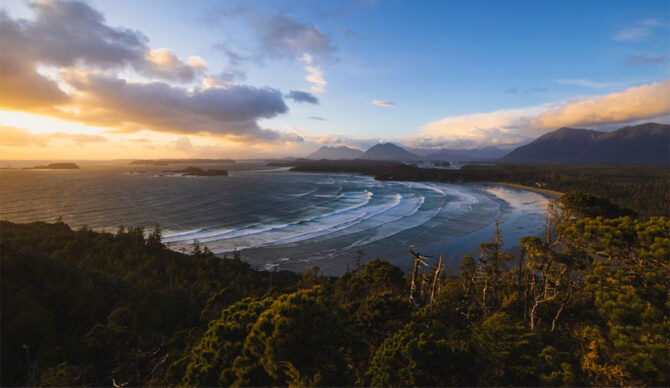
Tofino is one of the most beautiful places in the world, but a tsunami would be absolutely devastating. Photo: Unsplash

If you’ve been to Tofino, that wonderful little town at the end of the road on Vancouver Island, Canada, you’ve seen the blue and white tsunami evacuation-route signs. They’re there out of an abundance of caution in hopes of directing people up and away from a devastating wave, should one ever make landfall. But what, exactly, would happen if the unthinkable occurred? Well, a new study looking at the Cascadia Subduction Zone looked to answer that question.
Tofino is almost unbelievably beautiful. The waves get good, too, but what really steals the show is the backdrop. Vast, sandy beaches, often pounded by hammering rain, stretch along its ragged coastline. Whistle buoys sing their sad song in the fog. Massive old-growth cedars tower over the land, dwarfed only by the mountains surrounding the sleepy little place. And when the sun breaks through the clouds? Oh, it’s unforgettable. It’s all that and more that makes it a huge tourist attraction. Luckily, it’s a long way to go for some, so even on its most crowded summer days, it’s manageable. Those crowds, however, make it a worrisome place for a tsunami, let alone the locals.
The study suggests that if a major earthquake were to hit the Cascadia Subduction Zone (what Vancouver Island locals collectively call “The Big One”), it would cause severe flooding, building damages, and likely put thousands of lives at risk.
“Tofino is right on the Pacific Coast, so that’s the highest tsunami risk because the distance matters,” Katsu Goda, the study’s author and an associate professor of earth sciences at Western University, told the CBC. “The majority of the campgrounds, the resort hotels, et cetera, are all situated in the low-lying area. So that raises the risk level in Tofino.”
The Cascadia Subduction Zone is massive. Running from the north end of Vancouver Island all the way down to Northern California, it hasn’t had a giant rupture since the 1700s. The earthquake caused by that rupture, according to researchers, generated a tsunami that not only absolutely devastated the Indigenous people living on the coast, but crossed the Pacific all the way to Japan.
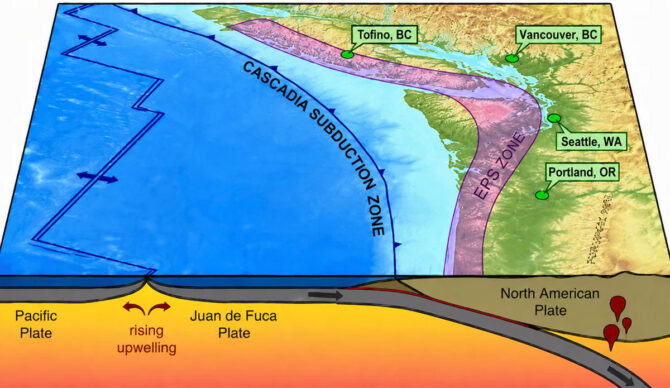
The Cascadia Subduction Zone is long and close to shore. Image: USGS
The Cascadia fault line ruptures every 500 years or so. Strangely, that’s a very wide average that doesn’t exactly tell the whole story. Although that is indeed the average, it’s not exactly a predictable thing. There are a handful of short cluster earthquakes followed by periods of quiet.
The study modeled only what would happen in cases of large earthquakes with magnitudes ranging from 8.7 to 9.1. About half the buildings in Tofino are less than 65 feet above sea level, which puts them at risk of collapse. The CBC reported that “most buildings hit by more than three meters of water would collapse or be washed away.”
Between the cost of a disastrous tsunami and the lives that likely would be lost — property losses could pass $1 billion and nearly 1,000 people could die — the study is one that should be taken seriously.
“I don’t want to emphasize the maximum values, but that is one possibility,” Goda said. “From a scientific perspective, that is a reality given the physical conditions in Tofino.”
One of the most dangerous aspects of a tsunami hitting Tofino is how fast it could arrive. The last stint of the road into Tofino is a coastal one, and it’s likely that if a tsunami was triggered by the Cascadia fault, it would reach land without much warning.
“One of our primary focuses for both residents and visitors is to educate people on what those early warning signs might be and how to act immediately, because you may not have time with a Cascadia event to wait for official warning signs,” Hilary O’Reilly, Tofino’s emergency program co-ordinator, told the CBC. “When it’s safe to do so, make your way to high ground immediately.”

