
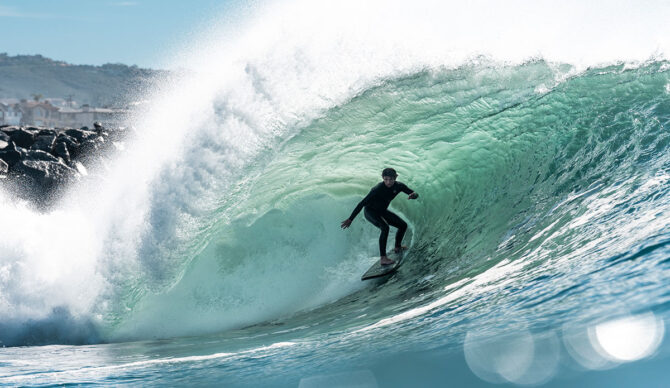
Sage Burke finds a tube during another big south swell at the Wedge earlier this year. Photo: Sean Evans

Even those living nowhere near the coast of Southern California this past week had little chance of escaping the powerful south swell that peaked on June 10, so pervasive was the ensuing media coverage (mainstream, Insta, YouTube, pod…take your pick) that in hyperbolic terms treated a run of much, much larger-than-average big waves as “big news.”
CNN: “Massive Waves Hit Southern California”
KTLA: “Another Round Of Massive Surf Expected Along Southern California Beaches”
ABC7 Los Angeles: “Massive Swell Brings Historic 20-Foot Waves to the Wedge In OC”
New York Post: “Monster Waves Wallop SoCal As 15-Foot Surf Sparks Beach Warnings”
SURFER: “Biggest Wedge Ever? 20-Foot South Swell Detonates Newport In Pure Carnage”
(Note: Virtually alone amid the heavy calls, The Inertia chose to hedge its bets with “One of the Largest South Swells In Years Is Slamming the California Coast”)
Yet even surfers normally reticent about using superlatives to describe any West Coast waves (other than Maverick’s) got in on the action. No less authority than the North Shore’s own Koa Rothman, who boldly titled his recent vlog episode “The Wedge, Biggest It’s Ever Been.”
Make no mistake, the swell was plenty big. The notorious Wedge, in Newport Beach, played the starring role, drawing thousands of spectators, with its “massive” A-frame refraction peaks, when shot from the jetty angle instead of straight on, doing a pretty good impression of a decent-sized day at Waimea Bay. Malibu at 10-12 feet, sending unwary “longest wave of my life” aspirants crashing through the pier in a foam-and-fiberglass demolition derby, the entire Trestles complex awash in whitewater, the lineups indecipherable; preciously-guarded winter breaks in “North LA County” and “West of Goleta,” head-high in June, and God only knows how big it was south of Carmel at…REDACTED.
Big, sure. But biggest ever? Koa’s headline got me thinking about a conversation I once had with the late pioneering California surfer/photographer LeRoy Grannis. This was way back in 1997, during a major south swell event, the very biggest I’d seen up to that point in my surfing life. I told him as much, and, taking into account his many more years of experience (a saltwater life that began in Hermosa Beach in 1931) asked him if he’d ever faced a south swell this big “back in the day.”
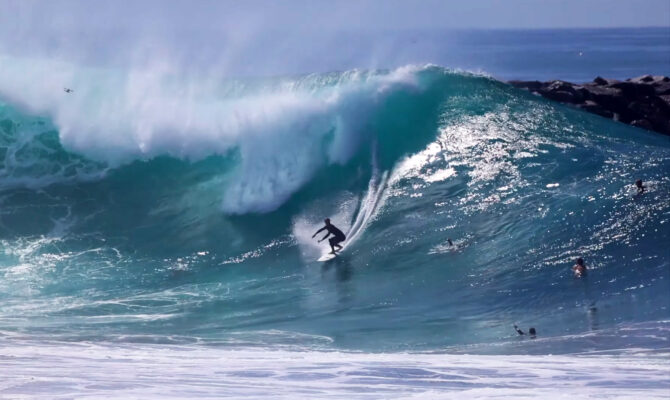
The Wedge this week, always a south-swell winner. Photo: Brad Jacobson//Screenshot
“Sam, you’ve never even seen a big south swell,” he said. “Because there hasn’t been a really big south swell since 1939.”
Late September, 1939, to track down an approximate date, when giant swells were generated by a tropical storm so large and powerful that on September 25 it became the first, and only, recorded tropical storm to actually make landfall on Southern California’s shore.
Known as the “1939 Long Beach Tropical Storm” (but more evocatively as “El Cordonazo,” referring to “cordonazo” winds, or “The Lash of St. Francis”), the monster’s spinning buzzsaw came straight up the pipe, with Long Beach/San Pedro taking a direct hit as it lashed the shore with Force 11 winds, torrential rainfall, and legitimately massive storm surf. The death toll on land reached 45, with a half-dozen unfortunates swept off the beach and drowned, while another 48 souls were lost at sea in inshore waters — literally a killer swell. Before the carnage, however, as the storm made its inexorable way toward SoCal, conditions were good and, according to LeRoy, the waves were great. Greater than great, but the biggest, most powerful south swell anyone had ever seen in the first three decades of the 20th century.
Malibu a consistent 15-feet, with every wave breaking outside of the pier; Rincon, double-overhead a month before Halloween; beachbreaks from Point Conception to Coronado totally out of control; the newly constructed Corona del Mar Jetty and Newport Harbor mouth closing out across the channel. We can only imagine what the Wedge must’ve looked like, the northern jetty having just been completed three years earlier in 1936. Probably full-on Waimea-sized.
“No,” Granny told me. “You haven’t even seen a big south swell yet.”
Then he said something that I’ve never forgotten. In fact, something I’ve spent considerable time thinking about since our conversation all those years ago.
“Considering their rarity,” he said. “You’ll be lucky to experience one, maybe two really significant south swells in your entire lifetime.”
Whoa. Talk about putting things in perspective — like most surfers I’d been living in a state of protracted adolescence, but just like that, LeRoy Grannis had me thinking about my lifespan. And about how many truly epic waves I could expect to experience during my allotted years…at least while still capable of riding them. It was a sobering thought. Again, like most surfers, I much too often found myself focusing on the waves I wasn’t getting, rather than the waves I’ve had – or the many waves awaiting me in the future.
Funny, then, how as the years passed, my conversation with LeRoy, who after a long, remarkable surfing life passed away in 2011 at age 93, troubled me less and less. Inspired, actually. Because instead of worrying about the all-time south swell that I may not get to experience in my lifetime, I took comfort in the thought that my best days of surfing may not be behind me, but waiting for me, decades away, perhaps, yet still out there beyond the horizon.
A simple concept, I agree, but one that I’ve found has helped me more fully enjoy every wave I ride, regardless of size, until my own “El Cordonazo” comes along.

