
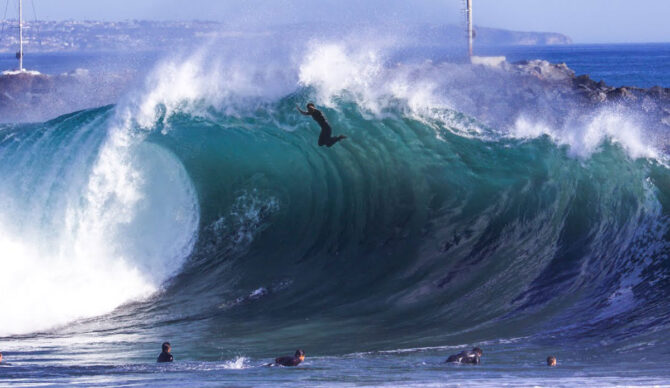
From the top rope! Newport Beach’s famous mutant wave. Photo: YouTube//Screenshot

“Massive surf, insane bodyboarding,” Wedge expert Brent Weldon told The Inertia last week. “And some of the biggest action we’ve seen in years at the Wedge in Newport Beach, California.”
The Wedge holds an iconic place in surfing. Now in 1936, the U.S. Army Corps of Engineers didn’t know they were creating a wave-reflecting mirror when it extended the rock jetty at the end of the Balboa Peninsula. Its 20-foot teepees breaking just meters from shore would have carved its own cultural rep, but its starring role in the 1966 film Endless Summer, which created the catchphrase ‘The dirty old Wedge,” cemented its status.
This June’s historic run of south swell topped up the Wedge’s institutional reputation and clogged the Instagram arteries, but also had us thinking about other surfing wedges. Those waves where a convergence of wave energy that creates that characteristic thick, doubling-up peak. A search on Surf-forecast.com, which has more than 7,000 surf spots, shows at least a dozen waves with “Wedge” in the title, including Blaketown (NZ), Kiama (Aus), Allenhurst and four in South Africa. But which are the best? We investigated.
Mandurah Wedge, Western Australia
The Mandurah Wedge, also cleverly abbreviated to “Medge,” is a side-valve of a wave, dominated by a heavy bodyboarding scene. Located just to the south of Perth, the lids catch one-foot foamies that ricochet off the breakwall and launch into the growing peak down the line. Thick swirls of back- and side-wash then provide additional vectors, and useful trampoline-like ramps for the volatile local bodyboarders to launch from.
Mohle Leste, Portugal
Tucked up in the far corner of Supertubos, and breaking 10 yards off a graffiti-covered rivermouth breakwall, this is a powerful right that comes to life often when the Atlantic swells prove to be too straight, or too much, for the famous beachies a mile south. Like most wedges, the takeoff zone is the size of a blanket, and so it’s easily fortified by the local surfers and bodyboarders. The wave, if you get one (as Mason Ho managed to do, above), is world class, with an opening backdoor section, followed by 100 yards of beltable, steep walls, and a final closeout air section.
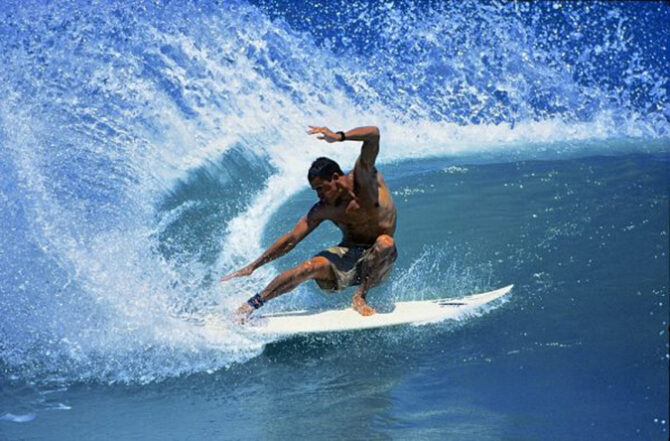
Kelly Slater, Sebastian Inlet. The photo above was named one of Australia Surfing Life’s “Best 50 Photos of All Time.” Photo: Tom Dugan//Eastern Surfing Museum
Sebastian Inlet, Florida
“Sebastian has deteriorated from when I was a grom, but it was a very distinct wave. Because it bounced off this jetty and created a wedge, it would make waves 50 percent bigger than anywhere else on the coast,” Kelly Slater once told The Inertia. “And so there was always a little pocket of energy at First Peak you could surf in Sebastian, even on the smallest days. That’s why that wave bred so many great East Coast surfers.” Slater’s iconic “Tomahawk Chop,” above, and the basis of his famous statue, was bred at First Peak.
Isabela, Puerto Rico
A novelty wedge near his home is what started Dylan Graves’ lifelong fascination with weird waves. When some of PR’s more conventional waves on the northwest coast would be firing, Dylan, along with Aron Geiger, Carlos Cruz and Hector Santamaria, would instead surf the side-washed, heavily wedged beachbreak. The fact that a takeoff spot is almost impossible to geo-locate meant crowds were never an issue, and over time, the crew got the hang of a wave that zippers in and around a small rock island and then wedges and crisscrosses to provide the odd barrel and huge ramps.
Tolcarne Wedge, Cornwall, UK
Located “In the Bay” on the more protected, north-facing half of Newquay, the Tolcarne Wedge rebounds off the headland and forms when enough of a high tide hits the rare, perfectly angled swell. With its shallow and short wedges, in a town full of slopey waves, the shoreys remain a rare and prized possession amongst Cornish bodyboarders and surfers.
The Wedge, Raijua, Indonesia
It might seem strange that Indonesia, an archipelago with more quality waves than any other on the planet, is a relative dead zone when it comes to world-class wedges. A lack of beachbreaks is one reason, as its plethora of offshore coral reefs shape Indian Ocean swells in the deep passes. That means the imperfections or shock and awe of a swell refracting off a headland or man-made structures are in short supply. We had to head east to the Wedge at Raijua, an exposed and remote left that ricochets off a wall of rock in the Nusa Tenggara region, near Timor. A crystalline peak rears up, offering a throaty backdoor section and a few high-torque performance sections in what is a rare, Indonesian wedge experience.
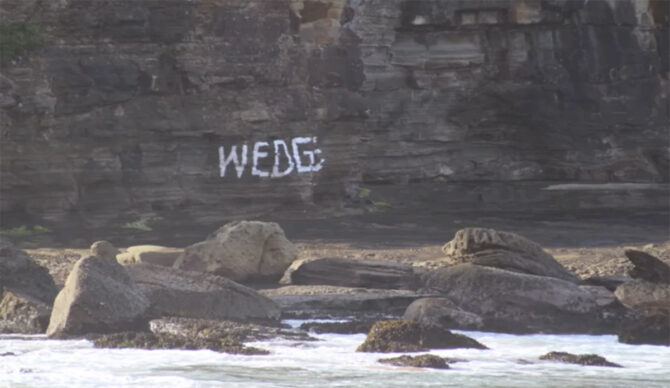
In case you needed a reference point. Photo: Screenshot
Whale Beach Wedge, Sydney
Whilst there may be better known, and, well, better breaks on Sydney’s Northern Beaches (Narrabeen, Dee Why, Deadmans, etc.), the Whale Beach Wedge holds an important place in the city’s surfing ecosystem. It sits at the north end of Whale Beach, overlooked by some of Australia’s most expensive real estate. The lefts that wedge off the headland are both consistent and punchy, and held down by “the Whaley Boys,” a crew with one of the highest average surfing levels anywhere in Australia. It’s easy to locate, just look for the giant graffiti “Wedge” that was painted on the headland (above) about 20 years ago.

