
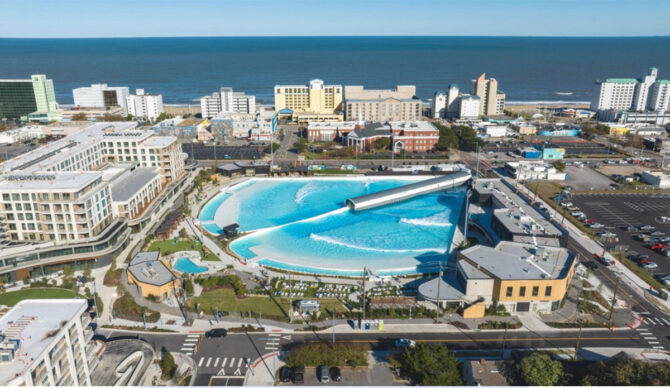
Surf lagoons are a big money business. Photo: Atlantic Park Surf Park, Virginia Beach, USA.

You may have noticed a trend in the last few years: wave pools are being built all over the world, but they’re not just wave pools. They’re a wave pool plus more. A wave pool plus condos, a wave pool plus shopping centers, a wave pool plus a spa. The wave pool is the anchor, but the ship is where the money is really at. And a new study from Wavegarden (biased, yes, so take it for what you will), says that developments with wave pools are printing money.
“From Brazil to California, surf-anchored projects are delivering exceptional financial returns,” Wavegarden reps wrote, “driving land value appreciation of up to 10 times, and redefining the economics of experiential real estate.”
According to the study, surf lagoons have IRRs (internal rate of return — a financial metric that calculates how profitable an investment might be) of up to 178 percent. Land values can increase ten-fold simply by building wave pools, too.
“Across five continents, Wavegarden-powered projects are demonstrating measurable, repeatable impact on property values, investor returns, and destination economics,” a press release reads, “evidence that surf lagoons are evolving from recreational amenities into a powerful new category of real estate infrastructure.”
There’s nothing new about the concept of “experiential real estate.” For years, golf courses have acted as a draw for hotels around the world. A simple chairlift has proven to up land costs exponentially in mountain towns. Surfing is growing, and it’s growing fast. Estimates state that there are around 35 million surfers around the world, and the wave pool taps into that interest.
“Wavegarden surf lagoons are stepping in as a next-generation alternative, functioning not only as premium experiential amenities, but as commercially independent assets capable of driving traffic, dwell time, and value creation across entire project ecosystems,” the report states.
It isn’t just words on paper, either. In Praia da Grama, a wave pool in the Fazenda da Grama of Brazil, KSM Realty created a surf-centered private neighborhood that paid for itself in just three years. Residential lots there sold at 10 times the price of units sold early in the process, and all 200 lots sold out within a few months.
The recently opened Beyond The Club in São Paulo, Brazil, is aiming for a similar record, and it looks to be well on track. It boasts Gabriel Medina as an ambassador, and it’s got a 78-room hotel, nine restaurants, elite athletic facilities, and advanced sports simulators, all built around a 62-module Wavegarden Cove, the largest in the world. With the proof in the pudding, it’s not much of a surprise that KSM Realty has plans to expand into other parts of Brazil.
“Wavegarden didn’t just add a surf lagoon to Fazenda da Grama, it completely changed the market perception of the development,” said Oscar Segall, CEO of KSM Realty & Founder of Praia da Grama. “What had been a slow-moving residential project suddenly became a lifestyle that resonated emotionally across multiple generations. The lagoon with its palm-fringed white sandy beach created a strong sense of exclusivity and demand that translated directly into accelerated sales and a substantial increase in land value.”
DSRT Surf, in California’s bone-dry Coachella Valley, includes the surf lagoon, a beach club with pools and cabanas, pickleball courts, a restaurant and bar, and a dedicated outdoor event space. There are plans in the works to add a 139-room hotel and 57 “beachfront” villas.
Feelings around wave pools are intensely divided, with purists throwing their arms up in frustration at the sort of uncanny, valley aspect of a man-made wave that acts like a natural one. There’s even a new competitive tour created specifically for wave pools. But with money flowing into developers’ pockets, it’s unlikely that this is just a fad, so we’d all better get used to it.
And who knows? Maybe it’ll lead to a great divide between pool surfers and ocean surfers and potentially thin the crowds out in doing so. Either that or things will go even further south, and we’ll soon all be packed into lineups like sardines in a too-small can. Whatever the future holds, it’s clear that wave pools are here to stay — and not just for the love of surfing, but for the love of the money that comes with them.

