
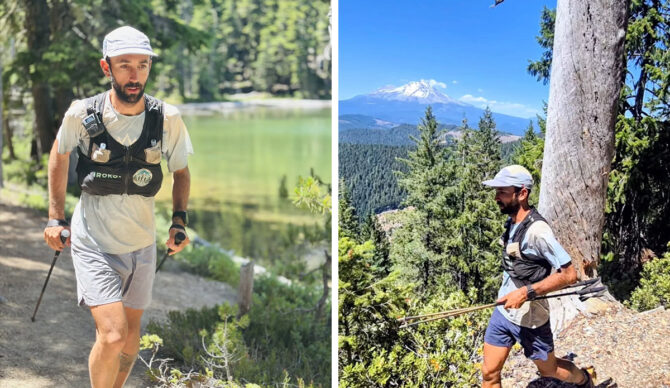
Aurélien Sanchez beat the standing Pacific Crest Trail record set in 2023. Photos: Aurélien Sanchez//Facebook

For most of those who embark on the Pacific Crest Trail (PCT), the 2,650-mile journey from Mexico to Canada is designed to induce a life-altering nature experience. The trail has seeped into popular culture via social media and the 2014 Hollywood film Wild starring Reese Witherspoon, causing the trek’s popularity to increase more than fourfold in the last decade.
But as thousands of hikers were moseying about the landscapes of the American West this year, Aurélien Sanchez ran right by them. On July 23, the 35-year-old Frenchman from Toulouse, whose trail name is Phoenix, completed the journey in record time: 46 days, 12 hours, and 50 minutes. He reached Canada just 16 hours ahead of the 2023 record set by Belgian runner Karel Sabbe.
While some celebrated Sanchez’s record, others were left scratching their heads wondering, “Why?” He had to run as many as 59 miles per day, sleeping little, battling fatigue, and hardly showering, prioritizing speed over basking in the lakes of the Sierra, or forging bonds with fellow thru-hikers.
To understand why, and how, Sanchez blazed through one of the world’s most popular long-distance hikes, we got him on the phone to chat about the Pacific Crest Trail experience, the challenges, and his motivations.
When did you first get the idea to attempt the Pacific Crest Trail record?
Realistically, it was one year ago. The first time I heard about the Pacific Crest Trail was eight years ago when I did the John Muir Trail. But the PCT is so long, I wasn’t really sure I was ever going to do it. I work full time. It’s difficult to get a month-and-a-half of vacation. I had only four weeks of vacation at that time. I really didn’t think it was possible for me to do such a long adventure. This year it made sense because I’m quitting my job and starting a new one. I had some time in between.
What’s your job in France?
I was an engineer in semiconductor devices for the automotive industry, but I’m going to open a restaurant in the next few months — a totally different thing.
When you completed the PCT record, did it surprise you? Or did you always believe that it was within your abilities?
It was not a surprise. I always believed it was possible. Otherwise, I wouldn’t have tried it. I knew my chances of succeeding were lower than my chances of failing, and I was okay (with that). I didn’t know if I was going to make it, but every day I was doing the same amount of mileage as the record, and every day I was progressing. I (began) feeling more confident that I was able to do it.
Towards the end, you were a little behind the record pace, and you had to increase your mileage. Was that challenging?
People like to compare record to record, but the previous record and mine had such different conditions. I knew one of the disadvantages that the previous record had was a forest-burn detour at the end of the trail. I knew I was going to take advantage of this. But during my attempt, I lost time in other aspects. Sometimes I tried to increase my mileage, but because I faced some difficult conditions, the day after I’d be really exhausted. Depending on the day, I was increasing, decreasing, and I knew at the finish I had some room to go for it.
What obstacles slowed you down?
The desert was so hot this year, more than the previous years. But that was not the main thing. The main one was really the blowdowns (fallen trees) and the vegetation. There are many areas where the forest is burned in Northern California and Washington and the trail is getting damaged because the trees are falling every winter. There were many storms last winter, and the Pacific Crest Trail Association can’t remove the blowdowns as fast as the trees are falling. I was very surprised because a lot of people told me after the Sierra, most of the difficulties are behind you. It actually wasn’t the case because in Northern California, the trail was really damaged. The vegetation was so dense. It was difficult to find the trail in some sections, and there were so many blowdowns that I lost a lot of energy. I slowed down, and I had less rest in the evening because I had to spend more time on the trail.
View this post on Instagram
What was the planning process like with your support team? Did you know exactly what you wanted to do, or did you have to adapt as you went?
I had a solid plan that I did myself with the FarOut application and the information I had online. To be honest, I really wished we had more support from the previous record holder. He didn’t want to share more (information) on the logistics. I think he wanted to protect his record, and I feel very frustrated about that. So I tried to figure it out myself. I spent months working on an Excel file, trying to find the road access points. So we had a plan, but we learned that many roads are not accessible. They’re either so difficult to access that we cannot use them, or they’re closed. We had to find Plan B on the go. Sometimes I was alone in the desert, and either I had to continue 10 miles to find the crew, or I had to wait for one or two hours for them to find me. So I had a plan, but it didn’t work well in some sections. I’m going to give advice to the next people who (attempt the record).
Is it normal in the ultra-running community for the record holders to help people who want to attempt their record?
For me, yes. It’s a small world. We don’t do this for money. We don’t do it for fame. We are not going to be a football world champion or an Olympic champion. We are talking about FKT (Fastest Known Time). It’s a small, inspiring community. I’ve done many FKTs. I have many friends who have done FKTs. We always contribute to each other’s projects. We always help each other. I don’t care about keeping my record. I know it’s going to be beaten at some point. Some people don’t want to help because they want to keep their record. That’s not what I like to do.
Many start the Pacific Crest Trail as a life-changing experience in nature, but running it nonstop is a different experience. Did you wish that you had more time to enjoy the different ecosystems?
Yes and no. If you told me I have six months right now, and I can do the PCT, it’s a big challenge with a big backpack. It’s a totally different experience, and actually, I like to go fast. My way is to run — to see a lot of things in the same day, different sunset, different sunrise, different area, a lot of passes, lakes. I do that so I can do something else after. I’m going to the Alps at the end of the month. I’m going to do the Tour de Mont Blanc with my girlfriend and some friends. Then we’re going to do the Tour de Géants. My girlfriend is racing as well. I’m not on the PCT right now, so I can do other stuff. I know people are complaining or saying that we go too fast to see the landscape and enjoy it. But that’s my way, and I like it.
Would you ever do the Pacific Crest Trail again just for fun?
Fully, no. The trail is too damaged for me in parts of Northern California and Washington. But I would do some sections again, for sure — the John Muir Trail, the Sierra, some sections in Oregon are so amazing, the volcanoes, Washington as well. But I will never do the PCT in one shot again because there are parts of the trail I really did not enjoy.
The PCT is very well known in the USA, but is it as well known in France? Do people understand how significant your accomplishment is?
Maybe not. There is a small community that knows about it — the hikers, the ultra-runners. But it’s less famous because we are in France, and there is a lot of hiking also around here. But since I finished, there has been some interest. People either know about it, or don’t know about it and (hear me) talking about it, so it’s nice.
What’s your next ultra-running goal?
My goal is to rest first, and then to help my girlfriend with her ultra-running challenges. Then I’m opening a restaurant. That’s a big project. It’s not ultra-running, but it’s very important for me. When I have time, I will think about it. But my goal is not to break records; it’s just to discover new things. For this year, I’m done running. Next year, we will see.

