
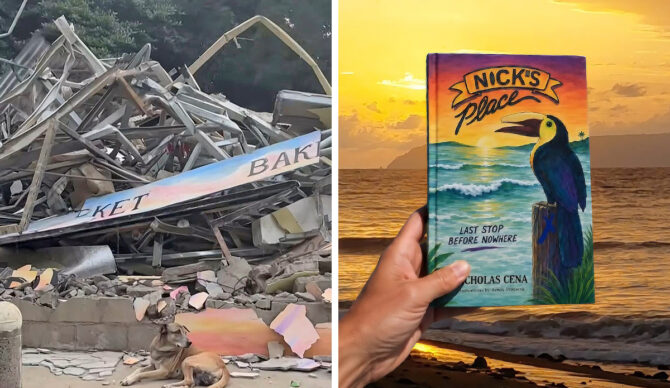
A week after the government destroyed Nicholas Cena’s restaurant in Pavones, Costa Rica, he started writing his story. Photos: Nick Cena

When heavy machinery suddenly started destroying the market next door — shelves still full of groceries — Nicholas Cena and his wife knew they had to act fast. They started pulling everything of value out of their restaurant in Pavones, Costa Rica, before their building was reduced to rubble, too.
Last year, the regional government agency arrived in Pavones with eviction notices for several structures on the town’s main road, claiming the land was not properly acquired under maritime laws governing the first 150 meters from the coast. They brandished 20-year-old maps that no longer reflected the current town grid – and used them as rationale for leveling buildings to reroute the road. Instead of offering compensation for the affected land and businesses, they sued the residents. After facing resistance from the community, the agency returned months later — with more force — and tore down a supermarket, a mechanic shop, two houses, and Cena’s restaurant, Nick’s Place.
But Cena says his building, where he opened his restaurant in 2017, had the correct permits. He believes the government’s actions in destroying people’s livelihoods only to move a perfectly functional road by several meters were irrational, had flimsy legal backing, and reeked of corruption. Just a week after his restaurant was obliterated, he started writing a book about his experience titled Nick’s Place: Last Stop Before Nowhere, which was released in April.
While the book is technically labeled fiction to avoid lawsuits, Cena says it’s 100 percent based on true stories. He encourages readers to Google the events in the book, assuring that they’ll pop up in a search.
The book “is not really about a restaurant — it’s more about what happens when a small surf town fights to hold on to its soul,” Cena told The Inertia. “And after everything that happened, including losing my restaurant, I felt that there was a story that deserved to be told. Fiction gave me the freedom to tell it in a way that is entertaining while still capturing what Pavones has been through.”
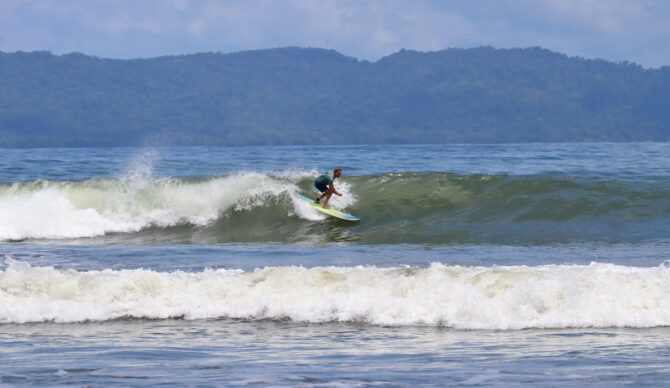
Pavones’ seemingly endless left-hander has long drawn surfers from around the world. Now, more dubious interests are taking notice. Photo: Laura Weaver
Cena, originally from Connecticut, fell in love with a local woman and moved to Pavones in 2011. He got married, had a kid, and opened his restaurant in the little surf enclave. Since he lost his business, he’s rebuilding at a new location down the road, which should open in two months.
But he’s worried about the future of the town. He believes it’s only a matter of time before the authorities return, as more buildings and dwellings with questionable permitting could be singled out.
Cena suspects that the government’s ultimate goal is to make room for developers, but he emphasizes that he doesn’t think development is inherently bad. The true key to Pavones’ future, he says, is to figure out how to create balance in an increasingly popular surf destination.
“The real question is, how do you let a place grow without destroying the region people fell in love with in the first place?” Cena said.
Cena wants readers to walk away from his book with a glimpse into the beauty and community in Pavones that they are trying to protect.
“I want them to smell the ocean, hear the waves, meet the people, and understand why someone can fall completely in love with a place like this,” Cena said. “The restaurant became a meeting place for surfers, locals, people who lived here for decades. They could all sit at the same table. The real story of the book isn’t a wave, it’s the people you meet because of the waves.”

