
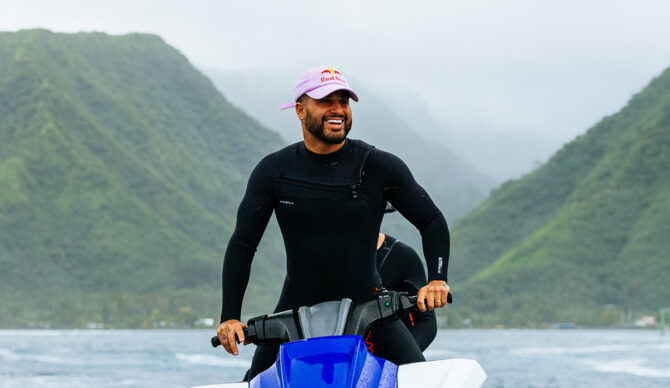
Italo Ferreira challenged his peers to broaden their repertoire instead of criticizing his aerial surfing. Photo: Matt Dunbar//WSL

Italo Ferreira did three nearly identical air reverses on one wave to win the inaugural New Zealand Pro Championship Tour event earlier this year. He scored a 9.33 on the Raglan cobblestones, and he’s not sorry about it.
Ferreira’s maneuvers on a left point break, a wave that usually would call for more traditional rail surfing, drew criticism from his peers. Brazilian surf journalist Guilherme Dorini, also a writer for The Inertia, recently asked Ferreira about the narrative on his podcast, specifically comments that Ethan Ewing and Morgan Cibilic made, that question how the judges reward Ferreira’s onslaught of airs. Ferreira didn’t back away from diving into the polemic debate of rail versus aerial surfing.
“I understand Ethan’s point of view in some moments,” Ferreira said. “But if I can get an eight, a nine (doing airs) on a wave that’s closing out, why am I going to wait for an open wave? I can sit below the guy, and get as many waves as I want, and the guy is only going to get a nine if the best wave of the day comes. But you only have 30 minutes, not all day.”
Ferreira, rightfully so, pointed out that he’s not a one-trick pony. He naturally learned airs growing up in the choppy, onshore waves of northeastern Brazil. But, even with financial barriers, he put in the time to learn how to surf some of the heaviest waves on the planet. He recommends that other CT athletes who grew up surfing perfect waves learn how to become more all-around surfers, too.
“I come from a place that is windy and messy,” Ferreira said. “So I went (to the heavy waves), I trained, I battled, and I won — Pipe and Teahupo’o. I still want to win Fiji. But (when I win these events, the critics) don’t say anything about me.”
“I had to adjust myself to the tour. Look at the wins I have on the CT. What’s missing?” he added. “I went to Indonesia for the first time when I was 26. You look at the other guys, they have photos when they were 12 doing trips. These guys can take a flight to Fiji in three hours, a flight to Bali in four hours.”
Ferreira challenged those criticizing him to adapt to the tour, learning a different style of surfing than the waves they grew up accustomed to.
“These guys come from incredible places with great waves, where it’s much easier to perform,” he said. “Surfing good (there) is easy. I want to see good surfing in bad conditions (too).’
Ultimately, Ferreira points out that he can mold his surfing to whatever conditions face him on tour. And as a world champ and two-time runner-up, there’s no arguing that. It’s simply smart to surf in a way that wins heats. He even went as far as insinuating that surfers like Ewing, complaining that rail surfing isn’t being rewarded enough, are doing so out of self-interest.
“It’s not my fault I know how to do this air, and it’s become ‘easy’ for me,” Ferreira said. “If this (maneuver) gets me a score, why am I not going to do it because another guy doesn’t like it?”

