
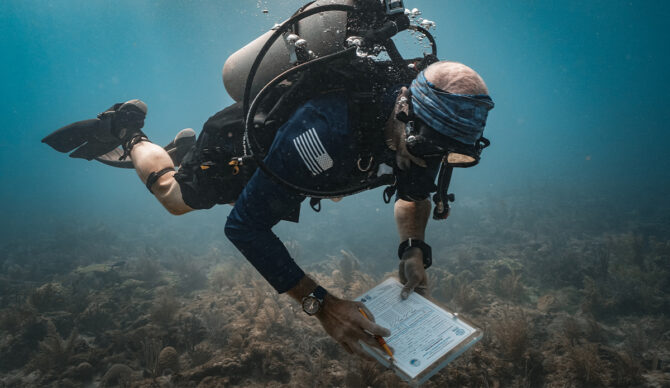
Armed with training on how to spott ailing coral the Force Blue divers combed the 100 Yards of Hope reef site. Photo: Force Blue//Luminox

Humans shouldn’t be able to breathe underwater. It goes against the laws of nature, millions of years of evolution, and common sense. And yet they can.
Well, not that many, actually. As Jim Ritterhoff tells me, only about 0.3 percent of the population can scuba dive because of the rigorous certifications. Which means that the ones with the ability have a special burden on their shoulders – because with the power to breathe underwater comes the ability to make a difference.
The non-profit Jim co-founded, Force Blue, is working to make that difference. The organization deploys dozens of special operations veterans and military divers to work with scientists in ocean conservation projects, from planting coral reefs to removing ocean debris. Along the way, they have also recruited a series of sponsors to their cause, including watchmaker Luminox, which created a unique Force Blue watch – but more on that later.
The whole thing started off with one diving trip. A friend of Jim’s was struggling – a Marine who had done multiple combat tours in Iraq and Afghanistan. “He was in a very bad place in his life, contemplating whether or not he wanted to live (tragically, that is not an uncommon phenomenon),” he explained. “I saw a friend who I wanted to help.”
Coincidentally, Jim, a diver since the age of 18, also had a scuba trip to the Cayman Islands lined up. Since the friend had been a diver in the military, he invited him to join. “Very long story short, we spent a week together, myself, him, and the guy who ran the resort, and we just saw him come back to life, like the way you see coral come back to life,” Jim continues. “Then we started talking about the challenges that the ocean’s facing, and that’s where we had the idea.”
That idea was simple – take special forces veterans and give them a new purpose. And while the veterans’ unparalleled skill in underwater operations is invaluable, Jim explains that the mission goes far beyond just making use of their unique military training. “We are not a diving organization. We are a mission organization,” says Jim. “It’s not about diving. It’s about using diving to do something. If it succeeds, it’s because we didn’t sit down to create a nonprofit to do this. We sat down to help a friend, and it was honest and it was authentic, and that’s what inspired it.”
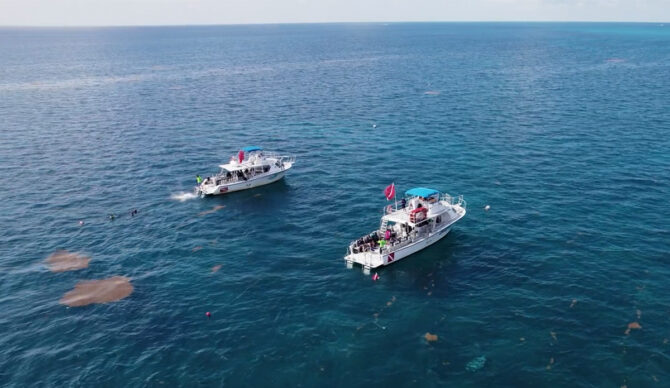
Key Biscayne’s reef faces unique stressors due to its proximity to a major urban center. Photo: Force Blue // Luminox
Now, 11 years later, they were on a reconnaissance mission, of sorts. The Force Blue team was diving down to the site of a previous project – a collaboration with the NFL called 100 Yards of Hope. In it, Force Blue divers worked with scientists from University of Miami’s Rosenstiel School of Marine and Atmospheric Science, the Phillip and Patricia Frost Museum of Science and the Florida Department of Environmental Protection to build a football field-sized plot of restored coral in the waters off Key Biscayne. Five years had gone by since the coral was first planted, and it was time to check on how the corals were doing.
Though everyone was putting on a brave face going into the dive, many seemed to be preparing themselves for disappointment. Of course, the environment is already pretty tough on coral (that’s why we were there in the first place), but the past five years have been particularly brutal, between hurricane events, coral bleaching events and disease.
In the pre-dive meeting, former Navy SEAL Master Chief Steve “Gonzo” Gonzalez likened it to BUD/S school, the grueling training program undergone by the storied special operations force, from which fewer than a third graduate. “It’s the hardest, the strongest that make it,” he tells us. “You can look at it and go ‘That really sucks,’ but also say ‘These are the strongest, these are the ones that are surviving.’”
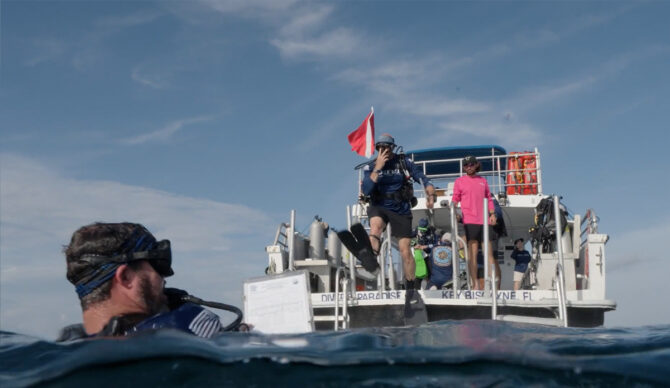
The dive begins. Photo: Force Blue // Luminox
With that sobering note, we set off. Once the boat reached the first of three patches of coral, the divers submerged as the rest of us watched from the surface. Armed with a crash course in identification of coral bleaching and disease, the Force Blue operators began to comb the ocean floor and see how close to BUD/S the survival rate actually was.
In between dives, I ask Gonzo if anything about these missions reminded him of his work in the military “Not really,” he says. And that was a good thing.
For example, something that multiple divers mentioned over the course of the mission was that military dives invariably take place at night – meaning many of them didn’t actually get to see a lot of ocean life during their work in the military. Also, the stress is immense. Gonzo tells me about how, on his first Force Blue mission, the sight of bubbles escaping his mask gave him a brief moment of panic, because he was so used to diving with a rebreather in order to avoid giving away his location. “Any bubbles escape, that’s bad,” he explained. ”So when I exhaled I was like “Oh my god!”
In a way, the transition to diving for Force Blue mirrors the experience of adapting to civilian life. And the benefits of it follow them out of the water, as well. “I’ve seen all of the evil in the world. I’ve seen the absolute worst in humanity,” Gonzo tells me. “Diving out here restores your faith in humanity, and just reminds you what a beautiful planet that we’re on.”
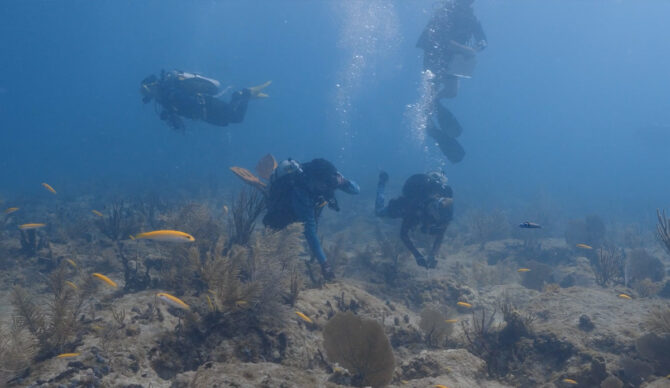
Though we were all preparing for the worst, when the divers returned to the boat, the tone was different. The guarded optimism became actual hope. Though there were some losses, they had found much more healthy coral. “I came away really encouraged,” said Dalton Hesley, a Senior Research Associate in Dr. Diego Lirman’s Coral Restoration Lab at the University of Miami Rosenstiel School. “We are seeing a lot of really healthy, large, mature colonies, which is phenomenal considering everything they’ve endured – multiple disease events, hurricanes, pollution events. So these are some of the best of the best, which was the point.”
The other point of the trip was to show off a new watch – a Luminox dive watch co-branded with Force Blue. While it is a nice little piece of business synergy, given Luminox’s longtime ties with the military, the partnership also felt very natural. The watch was designed with input from the divers, with dive-friendly features and stylistic details like a rope motif that hearkens back to the brand’s Navy roots. When Gonzo shows the new timepiece to me on the boat, he does it with an air of genuine pride. And things got briefly emotional as the weekend’s dive team was presented with their own.
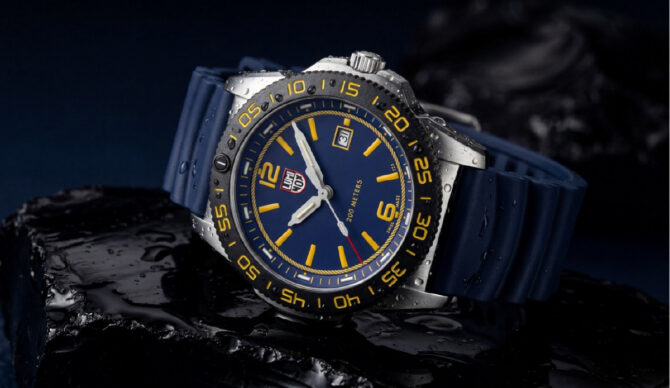
The watch is also a symbol, of sorts. “This watch isn’t a badge that you wear that says something about you,” adds Jim. “This is a tool for you to use to go out and perform, because every second counts. We need you. The planet needs you. If you’re wearing this watch, it means you have an ability, that 99.8 percent of the population doesn’t have, the ability to breathe underwater.”
And as much as that ability is a boon, and an excuse to wear an eye-catching piece of jewelry, it’s also a burden. “You have that ability. You have this tool. You have to go perform,” he says. “You have to go serve. You have to go do something.”

