
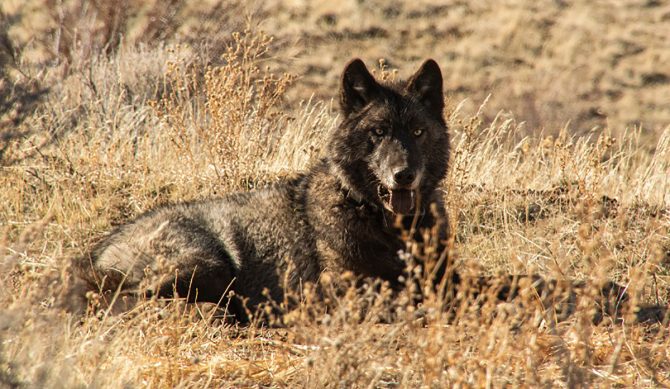
Gray Wolves are moving into California. As conservationists celebrate, ranchers are not amused. Photo: California Department of Fish and Wildlife

More than a decade since wolves began to repopulate California, a new study conducted by UC Davis researchers has revealed what the animals’ diet looks like — and the state’s ranchers won’t be surprised. California’s wolf packs are subsisting mainly on livestock, with cattle DNA discovered in 72 percent of the 105 scat samples collected between 2022 and 2023.
The findings suggest that the success story of California’s gray wolves is, at least in part, due to the ample cattle available on ranches, not necessarily an adequate supply of wild food sources.
“Wolves in California’s human-modified landscape primarily satisfy their caloric requirements through livestock consumption, underscoring the considerable challenges posed by coexistence of wolves and humans within the state,” the study reads.
Gray wolves disappeared from California in the mid-1900s. However, in 2015, the first pack crossed the Oregon border, settling in northeastern California. Now, the state has nine packs with at least 55 total individuals. While the packs are still concentrated in the north, one isolated pack has traveled south and settled in Tulare County. (You can track wolf GPS movements on the California Department of Fish and Wildlife’s website.)
According to the study, multiple factors could be causing the gray wolves to choose cattle. First, mule deer populations, which are their main wild food source, have been in sharp decline in California for several decades. From the 1970s to the 1990s, the mule deer population in the state’s northeast dropped from 950,000 to 250,000. Second, wolves have proven to adapt to their environments and seek out the food sources that require less energy and risk to capture.
Cattle made up 55 percent of the biomass in the wolf scat samples. Researchers found mule deer in 45 percent of them, and small mammals in 51 percent. The study notes that there’s no way to know whether the wolves predated or scavenged the cattle.
Early this year, the state announced a $2 million fund to reduce wolf predation on cattle, implementing techniques and equipment to deter wolves, while reimbursing ranchers for lost livestock.
The researchers say their findings underline the complicated nature of bringing a species back to a land that has drastically changed while it was gone.
“The ecological role of wolves in human-modified landscapes remains highly debated and poorly understood,” the report says, “leading to significant concern among rural communities and stakeholders who anticipate, or are experiencing, increased conflict from wolf predation on livestock and wildlife species that have both economic and intrinsic value to humans.”

