
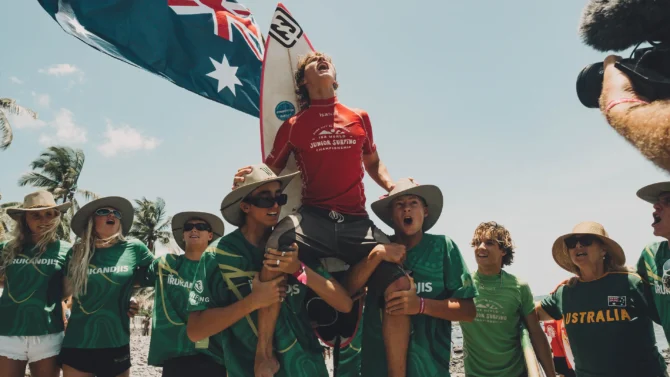
Locana Cullen was one of the Australians to come away with a gold medal at the ISA Junior Champs. Photo: Pablo Franco//ISA

While Australian women have had no problem collecting surfing world titles throughout the past decade, the Australian men are in the midst of a 13-year drought. But that should change in the next decade. The Australian youth movement is coming.
Last week, Team Australia won the ISA Junior Championships in El Salvador for the third year in a row. Leihani Zoric (girls U-18), Lucy Darragh (girls U-16), and Locana Cullen (boys U-16) took three of the four gold medals. Australia captured six of the sixteen total medals. It was utter domination.
Historically, the ISA Juniors have been a pretty spot-on gauge of future talent. If you can grind through a week of competition and eight or more heats against more than 400 surfers from 56 countries, you probably have a future in competitive surfing.
Many of the current Championship Tour surfers first proved themselves at the ISA Juniors — Gabriel Medina, Filipe Toledo, Steph Gilmore, Tyler Wright, Caroline Marks, Caity Simmers, etc. And 62 of the 71 surfers to qualify for the Olympics represented their country in the event.
So, Team Australia steamrolling the rest of the world’s youngsters several times in a row is a warning of the next generation of surfing talent. Dane Henry, who won an ISA junior gold in 2024, appears to be the first to usher in the new wave of Gen Z and Gen Alpha talent, having made his Championship Tour debut as a wildcard at Bells Beach this year.
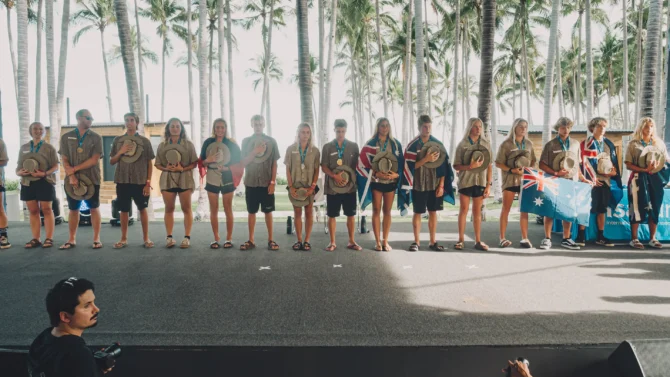
How many Championship Tour titles are standing on this stage? Photo: Pablo Franco//ISA
The Australians also dominated the ISA juniors in the 2000s, winning the event in 2004 and 2005 to 2010. If you look at those rosters, the gold medalists included Julian Wilson, Matt Wilkinson, Steph Gilmore, Jessi Miley-Dyer, Owen Wright, Sally Fitzgibbons, Laura Enever, and Tyler Wright. Those surfers went on to have quite successful careers.
The only thing that could hinder this wave of Aussies from matching the impact of what the Brazilian storm has done over the last 13 years is a change in the qualification system. When the WSL launched the Challenger Series in 2021, it limited the entrants per region.
This year, eight men and five women qualified for the Challengers from Australia. When the Brazilian storm was climbing up the Qualifying Series, no such regional limitations existed. Without that filter, you could argue that even more Aussies would flood the Challengers in the coming years.
So, when this impending generation of Australian youth starts knocking on the Championship Tour, what should we call them? The Australian storm doesn’t really have a ring to it. Time to start brainstorming.

