
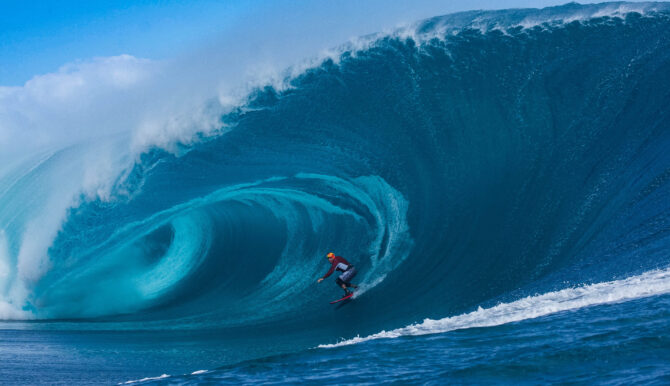
Garrett, deep in the pit of another famous wave. Photo: Romuald Pliquet

Garrett McNamara has become a global figure in surfing, thanks mostly to his career-defining feats at Nazaré. He became a household name after starring in HBO’s 100 Foot Wave docuseries. But Garrett took a long road to the top. Along the way, he bumped shoulders with the giants of big wave surfing, to whom he graciously thanks — as well at the islands of Hawaii — for shaping him into the person he is today.
“My brother Liam and I moved to Hawaii with our mother in 1978,” says McNamara. “We lived in Cement City, low-income housing on the North Shore. “Back then it was a rough place. We didn’t have much, but had what we needed. We lived on powdered milk, Frosted Flakes, and macaroni and cheese. Then one day my mom bought us a surfboard for $15 at a garage sale, and nothing else mattered.”
In those days, localism ran heavy on the North Shore. “We would walk two or three miles to Hale’iwa beach, carrying one board. Over time we built relationships with all the boys,” says McNamara. His list of legends includes elders and peers like Mike and Derek Ho, Eddie Rothman, Marvin Foster, the Terukina brothers, John-Boy Gomes, Dane Kealoha, and countless others. “The pecking order was real. If someone gave you the nod and let you go on a wave, you had to go,” says McNamara. “And if you didn’t, you may not get another nod that day or ever! If you disrespected someone you might not be allowed back in the lineup. You might even get sent packing to the airport. Open hand slaps were a common occurrence, and there was order in the lineup. Respect was earned.”
Tough love comes at a price, but he’s thankful that the price was right. “We were lucky to be accepted, but it was challenging too. On the North Shore, you can get mixed up in the wrong crowd and go in the wrong direction for a little while — or a long while. It’s a slippery slope.”
Ironically, Garrett was terrified of big waves. “I hung out with Fielding Benson and Jasper Warren. They had pro surfing careers based mostly on waves 10 feet and under, and I thought, that’s perfect. I actually vowed never to surf a wave over 10 feet after a horrible wipeout at Sunset, when I was about 15. Then, my dear friend Gustavo Laberte from Peru changed everything.”
Gustavo had all the toys, all the boards. One day he told Garrett, “You’re going to Sunset with me.” Garrett declined, but Gustavo grabbed him and said, “Punk, you’re coming with me.” Gustavo showed him the ropes — gave him a perfect board (a 7’10” Sunset Point gun shaped by Pat Rawson), and told McNamara where to paddle out, where to sit, and what waves to catch. “That day I fell in love with big waves. The crazy thing is, on the way in, I made it all the way to the beach and then creased his board in the shorebreak. So the day was a little bittersweet, but it changed my life. We’ve been so lucky, so many people looked out for us,” he says.
Once Garrett got a taste for bigger surf, the appetite grew. “I was on the beach at Sunset one day and Buzzy Kerbox, Darrick Doerner, and Dave Kalama took a Zodiac out to Backyards. It was solid 15 feet, maybe bigger, and Sunset was closing out. I saw them catching those first waves and I was mesmerized.” All three were of course part of a group known as the “strapped crew,” who pioneered tow-in surfing. Together with Laird Hamilton and others, the crew pushed the boundaries of what was possible.
“Crazy thing is,” says McNamara, “There are pictures of Duke Kahanamoku towing behind a boat with a girl on his shoulders. He started the idea. Then you got Herby Fletcher, Martin Potter, Tom Carrol and Michael Ho at Pipe. Herby jet skiing them into bombs, but Buzzy, Laird, and the boys definitely took it to another level.”
From that day forward, McNamara vowed to figure out the game. “I bought a big black Zodiac and refurbished it. I painted a red and white shark mouth on the front and started trying to tow surf with that. It didn’t work very well, and it was super dangerous because of the propeller. Then Charlie Walker and Dawson Jones, my mentors, bought a Sea-Doo jet boat together. That little Sea-Doo could fit three guys, and they taught me how to drive, how to tow, and how to get towed. We were riding big 7’6” surfboards back then. At first it was hard to learn because you had 30 feet of rope, and you had to understand that the ski or boat had to be 30 feet ahead of where you wanted the surfer to be.”
In 2002, at big wave surfing’s mecca, Jaws, Garrett scored the ride of a lifetime. “We showed up at Māliko Gulch in the dark. It was eerie. There was mist coming off the valley, and the road was full of debris from giant waves that had washed all the way up. Branches, Kukui nuts, and coconuts were cracking under the tires. We loaded the boards on the sled and headed out with my first sponsor, Roy Patterson. We got out there before sunrise,” says McNamara. “I was sitting in the channel on my board, up to my neck in water, at Jaws — a place known for tiger sharks. There were more skis and boats showing up, and then I saw Uncle Dane Kealoha driving by. He threw me the rope and the handle landed right in my hand. I looked up at him and realized I had never seen him drive. So I asked, ‘Can you drive, Uncle Dane?’ He gave me this look like, ‘Are you serious? You f*****n Haole. How dare you ask me that?’ The lineup was packed with 50 other Jet Skis. I thought we were going to go to the back and wait our turn. Instead, Dane drove straight into the pack, right through everybody. A giant set appeared, and nobody was going because Dane was driving. He put me in the perfect spot.”
View this post on Instagram
At Jaws, getting barreled is a tall task. That wave is powerful and hungry. No matter how far out in front you are, it wants to eat you. “That’s why they call it Jaws,” says McNamara. “I let go, faded back, then punched a bottom turn at the last second, and went right under the lip. The lip hit me two or three times on the way in. It brushed my head. Water blasted my eyes and I was blinded as I entered the barrel, I could feel that I was in the barrel. I kept thinking, I’m making it. I’m making it.” McNamara exited the tube with a hurricane-force spit and entered big wave history.
Garrett turned his eye towards design, searching for better boards for bigger waves. “I was very fortunate. My first tow board came from YU — Yoshinori Ueda . It was around 7 ‘6″. Then I worked with Gerry Lopez, who was working with YU, and we went down to a 7’2”, then a 7’ 0”, then a 6 ‘6 “. At first the boards were similar to normal surfboards, just glassed heavier, thinner, and narrower. For a while, smaller felt better, but once I got to six feet, I didn’t like going much smaller because there wasn’t enough rail to turn on.”
Weight became a huge part of tow-board design. “The early boards were glassed super heavy – six to 10 layers of six-oz. cloth, sometimes 20 pounds or more — especially for Jaws. Heavy boards stay connected to the water, carry momentum, and help you push through the explosions inside the barrel,” says McNamara. “Then I started working with Bill ‘Stretch’ Riedel. He put weights between my feet so there was no swing weight. That was a big breakthrough. You still had the weight to keep the board moving forward and connected to the water, but it turned faster because the weight was centered. Later, with Mercedes, we designed the ultimate tow board for Nazaré. We put the lead weight inside the board so there was no protruding weight. The exact placement was critical. If the weight was an inch too far forward, the board would bow steer. If it was an inch too far back, it would wheelie. It had to be perfectly centered between the feet.”
Nazaré, the monster wave in Portugal, would become an obsession for McNamara.
“Nazaré is different from everything else. There are no real channels. It’s a giant beachbreak, and it’s the choppiest big wave I’ve ever experienced. You kick out and you don’t know if your Jet Ski is going to be there or not. It is one of the most challenging waves in the world,” he says.
It all started with an email from local Dino Casimiro that read, “Can you come to our town and see if our wave is any good? If it is big and good, can you help us promote the town and help us create a contest here?”
“I asked him to send me a picture. He sent this crazy photo of a giant, perfect left and right with a Jeep on the cliff in the foreground. It looked a bit like Jaws, but with a cliff in the way. I couldn’t tell what was in front of the wave or if there were any safe zones. We emailed back and forth for about five years with pictures and swell updates.”
It was McNamara’s wife, manager, and spotter, Nicole , who stoked the fire to get out there. “I can honestly say that if Nicole hadn’t pushed me, I don’t think I would have gone. And Nazaré would not be what it is today.” But he wasn’t the first to try, Ross Clarke-Jones came when it was 60 to 80 feet and perfect. “They had Jet Skis, water safety, everything. They looked at it and saw there was no channel. Ross basically said, ‘We could probably catch a wave, but then what? How do you get back out?’”
“Jose Gregório was actually the first guy to tow it,” says McNamara. “After a bit they ended up losing everything. Total yard sale, everything floating everywhere.” It looked like an impossible challenge, so McNamara called up a big wave crew from Ireland — Al Mennie and Andrew “Cotty” Cotton. The trio rolled up to Portugal to test their mettle.
“The first day we went out and traded waves. On one, I ended up inside, and he had to rescue me. This was the first real test: could we get back out? Cotty drove all the way toward the beach, made a quick U-turn, and started flying over the whitewater. I was on the sled, and I could feel his confidence. He navigated one explosion after another and got us back outside. Andrew Cotton proved you could get back out at Nazaré.”
McNamara cut his teeth and paid his dues at the monster wave, eventually riding the (then) biggest wave in recorded history on November 1, 2011. A big wave media storm followed, with the race to catch the first documented and measured 100-foot wave. HBO’s eponymous docuseries would showcase big wave surfing across the world, with McNamara and his loved ones at the center of it.
“That’s another one I have to give to Nicole — the mastermind, the ringleader, the intuitive angel,” says McNamara. “Nicole wrote a treatment for a one-and-a-half-hour documentary about overcoming the impossible. It was about my shoulder injury, Andrew Cotton’s broken back, and her brother CJ’s back injury. We had all been told, in different ways, that we should not or might not ever surf big waves again. The film was going to be about healing, never giving up, and coming back stronger.”
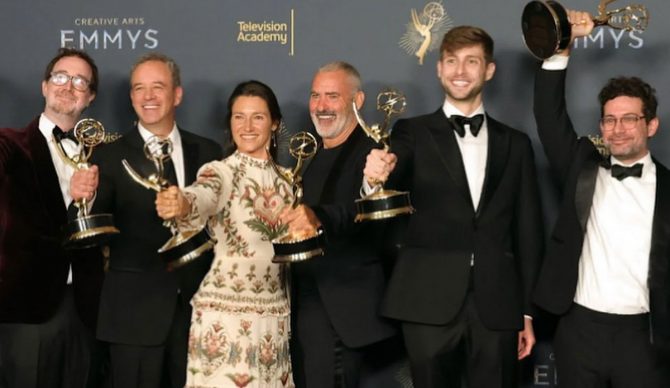
Celebrating 100 Foot Wave’s Emmy win. Nicole and Garrett in the middle of it all. Photo: Instagram//Garrett McNamara
A family connection, Joe Lewis, co-founder of Amazon Studios, greased the wheels, and proposed a docuseries. “They wanted to call it 100 Foot Wave. I said, ‘No way. We can’t do that.’ I wanted to call it Road to Nazaré. I thought it was more of a spiritual journey. But they were right. That was the best title. Now we are so grateful. 100 Foot Wave transcended surfing. It reached the world. It changed our lives, changed Nazaré again, and brought new people into surfing who never cared or even knew about it,” says McNamara.
The series isn’t just about surfing. It’s about fear, family, purpose, risk, love, failure, and resilience. “It resonates with the world because everybody has their own 100-foot wave in life,” he says.
And while McNamara has yet to officially climb the 100-foot mountain of water, he doesn’t really care. He’s reached a point in his life where priorities have shifted. “I’m definitely not attached to it, “ he says. “I don’t have to chase the monkey off my back. If I’m in the right place, if the wave appears, if it’s clean and glassy, if I feel ready, and if it feels right, I might grab the rope.”
He looks back on a long career, and asks what he can do to replace that ego of achievement with selflessness. “I surfed because I loved it. There was a lot of ego, pressure to do the next big thing. Now I’m asking, how can I help?”
The answer? The McNamara Foundation, or Waves of Life, which started by bringing the orphans of Nazaré on weekly surf lessons. It’s evolved and grown as a dual program in Hawaii, where it offers surf therapy mentorship for survivors of sex trafficking.
“The main goal is to become the best version of myself,” McNamara says. “The best version of myself wakes up in the morning, goes downstairs, reads a little, meditates, writes down what he’s working on, writes down what he can do better than the day before, and chooses what he will focus on that day — personally and professionally. When I live that way, I’m not wandering blindly. I have a purpose-driven life. I know what I’m working on. I know where I’m going. Every day becomes part of the path.”

