
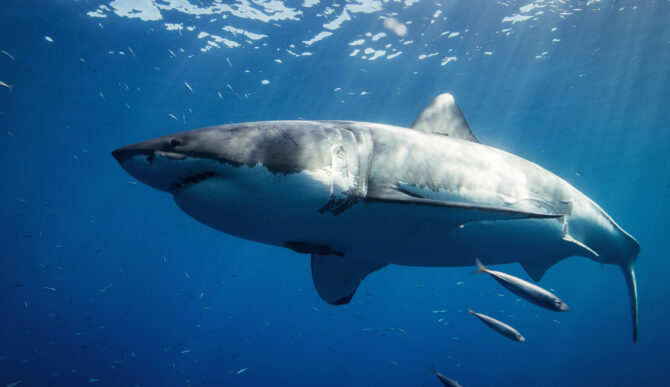
Great white sharks are breeding somewhere in the Mediterranean. But where? Photo: Gerald Schömbs

Last week I was in Cassis, a resort town on the Mediterranean about 20 miles east of Marseille. Being a surf journalist, and therefore highly paid, a week vacay in the French Riviera is, obviously, c’est la norme (insert sarcasm). Each morning, after a fresh croissant and café noisette, I’d slip into the azure bathtub at Plage de l’Arene and do the mile return swim across the bay. In summer, only one footers creeped down the rocky point, which can provide a decent-ish left-hander under the towering escarpment when the Med storms deliver.
Now sharks were on my mind. I was swimming in open water, and I’m Australian, so it’s part of my DNA. And that week, a few days after a surfer had lost his foot at Geraldton, West Oz, a swimmer had been killed by a six-meter great white 15 meters off the beach at Sorrento, Perth. The conditions weren’t too dissimilar to Cassis. Flat, clear water, blue skies and busy beaches. I could, however, rationally at least discount that threat. Or so I thought.
Well, according to new research, the Mediterranean might still have a breeding population of great white sharks. It turns out that back in 2023, local fishermen off Spain’s eastern coast, about 200 miles from where I was swimming, accidentally caught a juvenile great white shark, about six feet long and weighing 80-90 kilograms (about 187 pounds). They were after bluefin tuna, but encounters with great whites here are so rare that the catch alone was newsworthy.
It may have remained an unexplained bit of local lore until researchers led by Dr. José Carlos Báez from the Spanish Institute of Oceanography used the 2023 catch as the trigger to go back through Spanish and Mediterranean records stretching all the way to 1862. They recently published the full analysis in the open-access journal Acta Ichthyologica et Piscatoria.
Their review turned up 62 documented great white occurrences in Spanish waters over 160 years, concentrated around the Balearic Islands, including old reports of predation on loggerhead turtles. One of the more striking historical entries was that a great white had severed a bather’s leg at San Andrés beach, west of Málaga, in 1862. The most recent confirmed sighting before the 2023 catch was in 2018, when a five-meter great white was filmed near Cabrera, an uninhabited nature reserve island about 11 miles south of Mallorca,
The prevailing theory for all these sightings was that the adult great whites had wandered in from almost anywhere else. That the catch in 2023 was a juvenile made it a different story. As Dr. Báez put it, the occurrence of juvenile specimens raises the question of whether active reproduction may be happening in the region; a young shark is far more likely to have been born nearby than to have swam in from the open ocean. That’s the detail that started into a three-year research project with the theory that great whites could be breeding in the Med, and may have done in the past.
One of Baez’ working theories ties the historical Mediterranean great white population to two now-depleted food sources: Monk Seal colonies around Greece and Turkey, hunted to near-extinction, and Atlantic bluefin tuna shoals, hit hard by overfishing. As both declined, the sharks’ numbers likely declined with them, even as a small number appear to have stuck around to breed. A follow-up angle to the research suggests the sharks may still be tracking bluefin tuna migrations through Spanish waters today, meaning tuna conservation and shark conservation may be more or less the same project. The Mediterranean subpopulation of tuna is currently considered “critically endangered,” having dropped by at least 80 percent over roughly three generations, or the last 70 years.
A great white nursery, or a “ghost population,” could still be hiding where nobody’s watching. Look, the researchers aren’t suggesting the Mediterranean is quietly turning into a great white hotspot, and nothing about this study changes the actual risk profile of swimming or surfing in Spanish or wider Mediterranean waters. There is no real threat that can in any way be compared to the recent traumatic attacks in West Oz. However, what it does confirm is that a species assumed by many to have all but vanished from the Mediterranean never fully left, and that working out where it’s actually breeding is now an open, active question rather than a closed case.
Somewhere between the Aegean, Sicily, and the Balearics, there’s very possibly a nursery nobody’s found yet — which, three years on from one lucky/unlucky tuna boat off Alicante, might be the most interesting unanswered question in Mediterranean marine science right now.

