
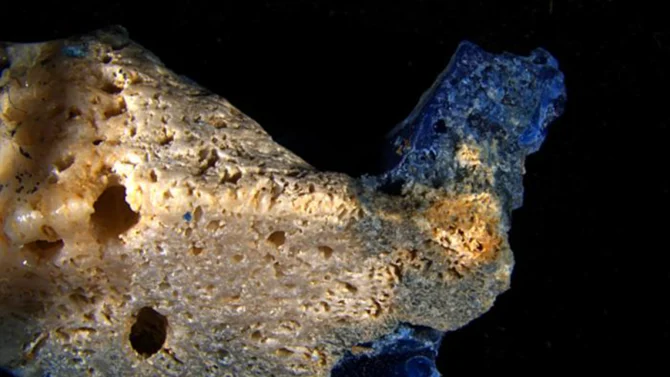
The plasticoral was collected on Sosu Beach. Photo: Ilechukwu et al., 2026 (CC BY-SA)

It’s pretty well known by this point in time that we humans are very good at throwing house wreckers. We’re rapidly destroying the planet we call home, and a recent study out of Okinawa, Japan, found something that is alarming, to say the least: the plastic scourge we’ve unleashed on the environment is finding its way into the very skeletons of coral.
The discovery, although not all that surprising, was a bit of an accident. While scientists were doing surveys on Okinawa, a few chunks of oddly bright coral fragment caught their attention.
After they took them back to a lab to get a closer look, they discovered that the bright flecks throughout the pieces of coral were tiny bits of melted plastic that had “melted inseparably into the very skeleton of the coral fragments themselves.”
The resulting material has been named “plasticoral” for reasons that should be obvious. Although the plastic in plasticoral might be pretty, it’s not good. The researchers suspect that the plastic embedded in the corals are likely leaching their chemicals into the surrounding waters.
It’s thought that the plasticorals on Okinawa were created when plastic was burned on the beaches. The melted plastics then found their way into dead coral and merged with it.
“As an emerging research area of marine litter pollution studies and geology, these plastic-rock formations present fresh ecotoxicological risks to marine ecosystems and could become potential stratigraphic markers of the Plasticene, especially in critical ecosystems such as coral reefs,” write the authors of the study.
The term “Plasticene” is a geological term for “a proposed new age or epoch dominated by plastic pollution.” This is not the first time researchers have found plastic merged with natural parts of our world. Back in 2023, scientists found rocks made partially of plastic that were formed when volcanic activity melted the plastic into the porous sedimentary rocks.
“This new plastic variant provides fresh perspectives on the persistence of plastic litter in coral reef environments,” the study’s authors wrote, “and highlights the potential for plasticorals to serve as future stratigraphic markers within the contemporary sedimentary record of tropical reef systems.”

