
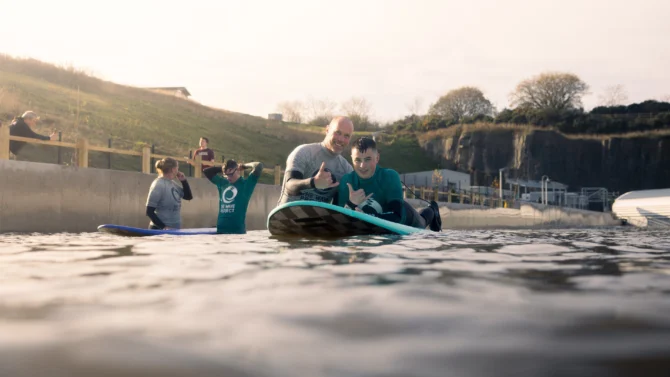
Surfing is good for you, no matter where you’re doing it. Photo: The Wave Project

It should be pretty obvious to anyone who has surfed that it’s good for the body and the soul. There’ve been countless studies on surf therapy proving that surfing is a lot more than just physical exercise, but those have mostly been done at beaches. With wave pools becoming more and more prevalent, The Wave Project, a mental health charity focused on the impacts of riding waves, decided someone needed to have a look into whether wave pools offered the same help. Turns out they do.
“The Wave Project has found that young people taking part in its Surf Therapy programs at inland wave pools experienced significant improvements across every outcome measured,” the researchers wrote, “with improvements comparable to beach-based programs on four out of five measures.”
Children’s mental health services in the UK have seen an uptick in referrals in the last few years. Whether that’s because more kids require them or because more services are available and more parents are aware of them could be up for debate, but either way, nearly 1.5 million kids were assisted by UK mental health workers in 2024-2025.
Using data from 22 natural beaches and two wave pools, the researchers looked at 360 children in 2025. They put them in inland wave programs for surf therapy sessions — one at the Wave in Bristol and another at Lost Shore Surf Resort in Edinburgh — and looked at the results, then compared them to the results from the kids who participated at beaches.
“Against the backdrop of a ‘perfect storm’ of challenges facing children and young people, with increasing pressure on public services,” a paper reads, “new research from the UK’s leading Surf Therapy charity has found significant positive outcomes for young people taking part in their surf therapy programs on the coast and at inland wave pools.”
In nearly every measured outcome, the kids fared better. Wellbeing, self-belief, perseverance, pride in achievements, and connection to others all increased after six weeks of surfing in both the ocean and a pool.
There were a few differences, though. Wellbeing rose by 20.1 points at beaches and only 10.6 at wave pools. Still, any rise in overall wellbeing is a good thing.
“What the research shows is that, while coastal and inland settings aren’t identical, young people experienced significant positive outcomes in both,” said Ramon Van de Velde, CEO at The Wave Project. “At a time when children’s mental health services are under enormous pressure, we need to think creatively about where preventative support can be delivered. Blue spaces, including inland surf facilities, have the potential to play a huge role in wellbeing. Our vision is that every child and young person who could benefit from The Wave Project’s support can access it. This research gives us an important foundation for exploring how we can make that vision a reality, reaching more young people in more places.”

