
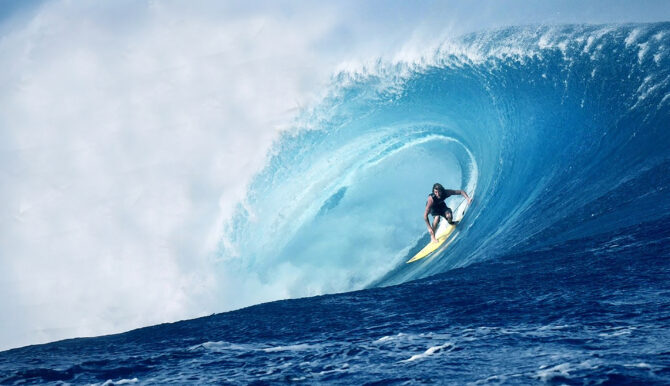
When it’s good, it’s good! Photo: Bonython

Cloudbreak is basically a perfect wave. It’s a wave that, especially when it’s big, looks almost manageable for the Average Joes. Sort of, anyway. It’s a wonderful wave to mind surf, at least. It’s one of those waves that behaves like a regular wave… except it can get giant. Tim Bonython has been around the block a time or two, and of all the waves in all the world, Cloudbreak is up there with his favorites.
He’s been going there for a long time. The first was back in 1987. It was a bit of a wild goose chase, and it didn’t work out exactly as he was expecting it to. But it was an introduction to a place that captured his heart.
“I was looking for the Billabong surf team on Tavarua Island,” he explained. “Back then there was no internet of course; no mobile phones either, so I just winged it thinking they were on the island. They weren’t. God knows how many times I have been to Fiji as I went mostly to film for Quiksilver & Globe pro surfing events staged there back from 1999.”
This edit from Bonython, however, is not about his history with Tavarua. It’s about a trip to Cloudbreak that was a gamble — just like his first trip — but for a different reason. It was a gamble because the conditions were not ideal.
“The storm generated through the roaring 40s underneath Tasmania,” Bonython said, “with seas biggest around 35 to 40 foot mark. Straight up pinball alley thru the Tasman Sea straight into the island of Fiji. The only issue in the forecast was the winds once we got there. Simply stated, the winds were going to be strong south easterly, which is not ideal.”
After weighing his options for a while, Bonython heard that Kala Grace, Kai Lenny, Lucas Chumbo, and Pedro Calado were going to be there, his decision was made. He ended up connecting with Aussie surfers Lex O’Connell, Fletcher Kelleher, and Luke O’Connell, as well as a handful of locals like Che Slatter, Teo Degei, James Kusitino.
What came next was four days of bombs at Cloudbreak. And it doesn’t get much better.

