
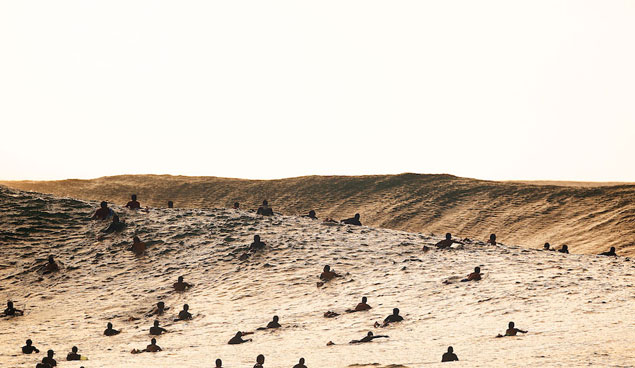
Ancient Hawaii did not look like this. And if it did, you can bet the vibe would be very different. Photo: Alex Marks.

Ancient Hawaii. Any bit of research would show you that, in the time before the arrival of another civilization, Hawaiian culture was highly developed. In fact, they had the same intimate relationship with the ocean as they had with the land.
The climate in Hawaii was ideal; the growth of food abundant, fresh drinking water overflowing. There were no highly dangerous animals in the forests. Hawaiians celebrated life by expressing gratitude through social communication and openness, dancing, singing, and by focusing on playing. Because of their surroundings, social culture, naturally aligned technology, and isolation from the rest of the world, they had the perfect combination for the true meaning of leisure time.
Above all, they were able to develop the wisdom of life. The beach, the ocean, and its waves were a place where they could extend their wisdom of how to live on land. It was in their nature to be humble, observant, patient, adaptable, persistent, athletic, spontaneous, intuitive and expressive. Surfing was an experiment that was bound to be successful because of how they lived. That is why they all surfed, regardless of socially conditioned roles. And that is why they saw surfing as an extended celebration of life lived on land. It was more about the ocean, life and water than about waves and performance. Riding waves was seen more as an achievement and a reward at the same time.
Shift ahead to modern times, when nature is, by and large, seen as an opponent that needs to be managed and eventually turned into man’s servant. Being quiet and observant seems in contrast with today’s promotion of active participation in style. What would happen if we erased all collective memory of surfing and threw a typical modern individual into the ocean? How much time would it take for her or him to understand that waves can be ridden?
Surfing is becoming a mainstream sport across the world, yet its culture is lacking in content when it comes to understanding the depth of its transformational powers on the individual, and on society in general. The reason for this is that when surfing grew in popularity, and it is only starting to exponentially spread around the world and even moving into landlocked countries, it was already void of cultural traditions of ancient Hawaiian people. While estimates vary widely, there’s somewhere in between 5 and 35 million surfers worldwide at the moment. The upper portion of that is more than the population of Australia.
Let’s use our imagination and put all the surfers in the world into one country. Let’s place them all in Australia, since it has great surfing conditions throughout the year. We assume these surfers will be mostly accustomed to the modern global civilization and its technological and information-based capital culture. Do you think the vibe on the beach and in the water would even remotely resemble the temple-like ambient of reverence in ancient Hawaiian times? Go to any beach today, observe, and see for yourself.
I have talked to countless surfers around the world about surfing’s lost cultural heritage, and even though they could not pick out what exactly that means, they all resonated with the idea that there is something missing in lineups worldwide.
When we try to incorporate attitudes of the modern civilization into surfing, it loses its true effect and appeal, because surfing’s origins are so different from our modern civilization. If we assume waves are a finite resource, paddle battles occur, and a peaceful session goes out the window. If we assume that there is not enough space for us to express our fluid personality in the waves, other people appear as rivals and aloha becomes only a word. If we deem the wave ride to be the only goal of visiting the ocean, then the joy of leaving gravity behind by immersing in a liquid medium is hard to attain. If we deem conditions to be good or bad, a session is bound to become another box with a sticker label.
Surfing has the potential to become one of the social wheels of change towards respecting natural habitat, sharing resources and reestablishing existing systems from capital-based to human-oriented. Surfing’s very essence of origin is people who understood life. And each and every time we go surfing, regardless of what craft we use, we tap into that wisdom.
In the last ten years, I have visited lineups across Europe, Hawaii, and Australia, along with long stays in Mexico and Indonesia. It became apparent to me that our global society started running away from issues on land only to realize they cannot be solved in the ocean by acting the same way.
The irony is that we all surf as it soothes sores of life on land. Sure, you can overpower others by paddling, you can say waves are bad, you can treat others without respect or do anything else that emotionally balances you, but that ensures that surfing will not really touch you. You can surf that way for decades, and you will stay trapped in the same pattern of behavior. Or you can calm down before going into the ocean. Take a minute to let go of any worries and issues on land.
Ponder for a second what it is that blocks you in your personal journey. Is it impatience? Is it the lack to observe and identify opportunities? Is it the lack of confidence in your abilities? Is it the lack of courage to let go and trust the process of life? Is it weak willpower to endure wipeouts, momentary currents or changing conditions? Is it stubbornness and resentment to adapt your behavior to the circumstances? All of can be practiced and experienced in the ocean, and the ride itself becomes an effortlessly attained reward.
Imagine a lineup where every single person understands this and encourages everyone else towards personal excellence.
We are living in times of global crisis. The crisis is uniquely ours –humankind’s – and we have lost our kindness to humans, let alone to other species and natural elements. The surfing community faces a challenge to resurrect the ancient wisdom of the very same people who unconditionally shared with us the science of riding waves. As a collective tribe, we have the ability to spread the message that everything in life happens in waves around the globe. Surfing goes beyond art, a lifestyle, a sport or a profession. In its essence, it holds the teachings of how to live. Every time we go for a session, we sign up for some therapy time. Determination. Generosity. Truthfulness. Courage. Compassion. Insight. Morality. Peacefulness. Loving kindness. All those teachings are at the tip of our nose when we go into the ocean. I love learning them while surfing the crowded, globalized civilization-fueled lineups of the Gold Coast. They are a perfect place to walk the talk. Just the other day in Coolie, I got waves all session long that were free of paddle battles, while chanting in my mind: Mahalo, Mahalo, Mahalo… Aloha.

