
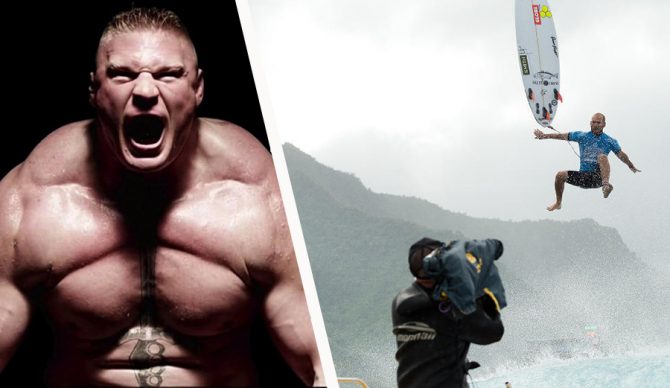
Both are athletic freaks. But only one is going to get the average sports fan to regularly tune in.

For years The Ultimate Fighting Championship has promoted itself as the fastest growing sports organization in the world. Its $4 Billion sale to the talent agency WME-IMG this week is a pretty heavy and profitable feather in the cap of that claim – the most expensive transaction for any organization in sports history. Adding a little more “holy sh*t” to the plot, the UFC’s previous owners, Lorenzo and Frank Fertitta are looking at a profit margin of $3,998,000,000 after they purchased the MMA promotion for $2 million in 2000. The Dallas Cowboys are the only sports team in the world with that value ($4 B) in 2016, according to Forbes.
Am I about to compare apples to oranges? Some might think. Should non MMA (surfing) fans pay attention? Certainly, and here’s why.
First thing’s first, UFC is just one organization within the entire professional mixed martial arts game. It’s the major leagues of the fighting game, not the sum of the sport itself, similar to the World Surf League serving as surfing’s biggest stage. And through the decades professional surfing has seen rebranding after rebranding in an attempt to grow the sport’s profile…or value, depending on how you look at it. The direct lineage leading up to the current World Surf League started with the International Professional Surfers. IPS was a “ragtag” collection of contests according to the Encyclopedia of Surfing from 1976 until 1982. In ’83 the organization evolved into the Association of Surfing Professionals, which had a nearly 30 year run as top dog before the media group ZoSea acquired media rights for the tour in 2012. That partnership is responsible for what we know now as the rebranded World Surf League, an organization that’s emphasized growing the sport’s profile with its global webcasts. CEO Paul Speaker is a former executive (among many other titles on his resume) in the National Football League, an organization whose 32 teams hold a combined estimated value of $62 Billion today.
A year ago Speaker made a guest appearance on FOX Business Channel, detailing the newly rebranded organization’s business potential to the network’s surf illiterate Stu Varney. They talked money, they talked Kelly, they talked Cloudbreak (the TV spot took place shortly after the 2015 Fiji Pro). But Varney really only wanted to talk sharks.
Eerily, the interview took place right before the WSL headed to South Africa for the J-Bay Open. And at one point Varney circled back to his “you’re selling the wipeout” angle when b-roll of sharks appeared on the screen, suggesting that people will only tune in to contests on a NFL/UFC ratings scale if fans anxiously await disaster.
“It’s a dangerous sport,” Speaker said.
“And that’s what makes it attractive, isn’t it? You see, you’re selling danger,” Varney replied.
We all know what happened next. As if it had been predicted by the FOX television host, Mick Fanning had his run in with a shark and surfing became about as sensational and popular as it could get.
40 years of professional surfing and three versions of the world tour we now know, and a man in fear of his life against the ocean’s apex predator is what it took to make surfing as “popular” as it will ever be to the average sports fan. You can’t sell more danger than that. Meanwhile, an organization that locks two people in a cage and gives them 3-5 three minute rounds to render the other unconscious is now certainly selling the you know what out of its brutality. The $4 billion sale is a marker for that, all just over 24 hours after the company held an event that brought in record revenue. Brock Lesnar made $2.5 million just for showing up to his non title fight. UFC 200 recorded gate sales of $10.7 million, and Jon Jones is estimated to have lost out on as much as $10 million for not fighting. All this without Conor McGregor, Ronda Rousey or Jon Jones – arguably the sport’s three biggest/most mainstream names – on the card.
That kind of money inevitably attracts athletes – young people with enough talent to pick and choose their future endeavors like football, surfing, soccer, basketball and now, MMA. Coincidentally, both MMA and surfing share some crossover in fan bases. Both are massively popular in places like Hawaii and Brazil, and can each be considered niche sports (maybe not so much the case for MMA now).
Anybody hoping the WSL’s focus on building a more fan friendly brand doesn’t equate to more heads in their local lineup can interpret this as good news. The core surf audience doesn’t care if professional surfing advances the sport overall because that translates to more surfers. And truthfully, surfing is a tough sport to dumb down for the average Joe sports fan anyway. So the WSL works with what they have, creating programming and partnerships they believe can satisfy their core fans and be easily digested by the surf illiterate.But maybe watching another organization half its age make $4 billion is proof that surfing doesn’t have a consistent enough dose of “danger” to sell to its audience.

