
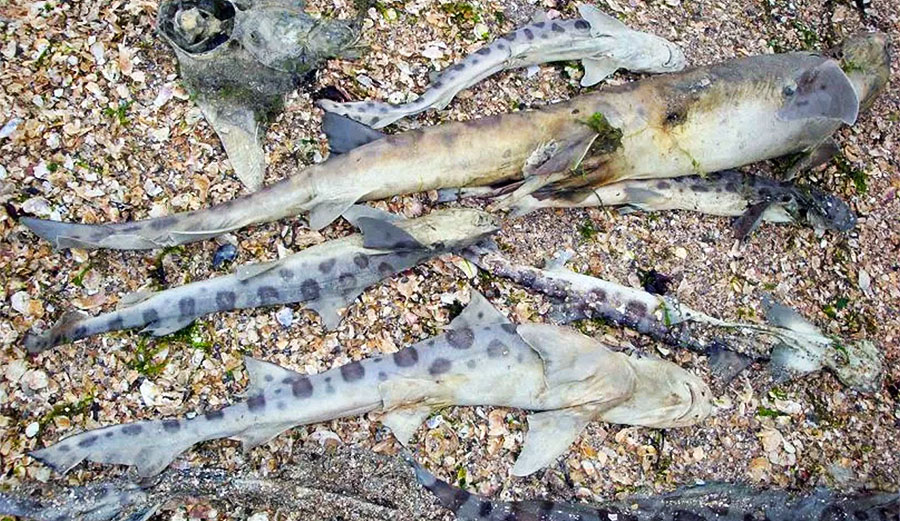
These leopard sharks were found dead on April 26 near Foster City. Photo: Mark Okihiro/The Mercury News

For the last few months, hundreds or perhaps thousands of leopard sharks have been washing up dead around the San Francisco Bay area. Leopard sharks aren’t dangerous to humans. It’s gone under the radar because live sharks are much scarier than dead ones, but it’s a troublesome issue.
“They appear to be stranding themselves,” Joshua Porter, a marine biologist with the East Bay Regional Park District, told The Mercury News. “Park users have pushed them back in the water, but in all reality, they are going to die or work their way back to the sand. When they beach themselves, there’s no coming back from it.”
According to the San Francisco Chronicle, Dr. Mark Okihiro, a fish pathologist, released his findings on May 31st. After examining three of the sharks, he found they all shared a common pathogen. There are a number of theories being floated, but the executive director of the Pelagic Shark Research Foundation, Sean Van Sommerman, believes that it’s linked to San Francisco’s tide gates.
Since leopard sharks venture into shallower water this time of year to mate, they’re often trapped behind the tidal gates when they close. It’s common for them to die there, washing back out to sea when the gates open again. Of course, by then their bodies are rotting and full of toxins, infecting the other sharks.
Other researchers think the heavy rains have something to do with the die off. The runoff may have reduced the salinity in the bay, possibly weakening the sharks’ immune systems. “They go from being able to regulate their internal salt content to not being able to,” said Jim Hobbs, a research scientist at UC Davis. “It causes a whole variety of impairments. They can’t excrete toxins that build up in their bodies.”
During his necropsies of the sharks, Okihiro found a fungus that “appears to have invaded the sharks’ bodies through their noses and ducts in their heads, indicating that they may be dying from some type of fungal meningitis.”
While it’s still a mystery, Okihiro is working with researchers from UC San Fransisco and the University of Florida to come to a definitive conclusion.

