
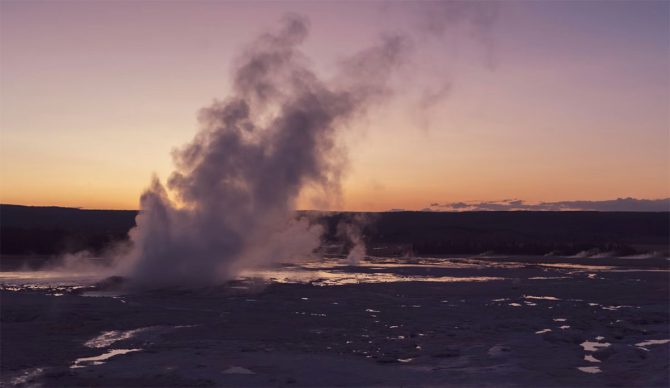
It’s even rougher underneath Yellowstone National Park than we thought. Photo: Unsplash

Yellowstone National Park is not a calm place. Sure, it’s quiet and peaceful, but bubbling away beneath the surface those many tourists walk upon is a deep well of violence. We know that, of course, but a recent study that used AI technology to see just how violent it is showed us that it’s even less calm than we thought. The caldera beneath the vast swathe of land created 10 times more earthquakes in the years between 2008 to 2022 than we were able to record using more older methods.
The study, titled “Long-term dynamics of earthquake swarms in the Yellowstone caldera,” and published in the journal Science Advances, found that there were over 86,000 earthquakes in that time in the Yellowstone Caldera region.
“We leveraged leading-edge deep learning algorithms and a detailed three-dimensional velocity model to construct a 15-year high-resolution earthquake catalog of the Yellowstone caldera region,” the researchers wrote. “More than half of the region’s earthquakes are clustered into swarm-like families characterized by episodes of hypocenter expansion and migration.”
In layman’s terms, they used AI to look at the huge amount of data recorded in a far faster manner than people ever could. The technology was able to identify patterns that were lost in the shuffle.
“If we had to do it old school with someone manually clicking through all this data looking for earthquakes, you couldn’t do it,” said Bing Li, study author from the University of Western Ontario, in a statement. “It’s not scalable.”
It’s important work, and not just because it helps us better understand our planet for the sake of understanding it. The new information could go a long way in increasing public safety.
“By understanding patterns of seismicity,” Li explained, “like earthquake swarms, we can improve safety measures, better inform the public about potential risks, and even guide geothermal energy development away from danger in areas with promising heat flow.”
The Yellowstone Caldera was created when a huge volcano erupted over 600,000 years ago. It’s an area rife with seismic activity, and it’s potential for disaster has been behind more than a few disaster films. Although a scenario like the world-ending films portray isn’t all that likely, knowing more about what’s happening down there will serve researchers greatly in figuring out the many unanswered questions that still remain.
“We have a far more robust catalogue of seismic activity under the Yellowstone caldera,” Li said, “and we can apply statistical methods that help us quantify and find new swarms that we haven’t seen before, study them, and see what we can learn from them.”

