
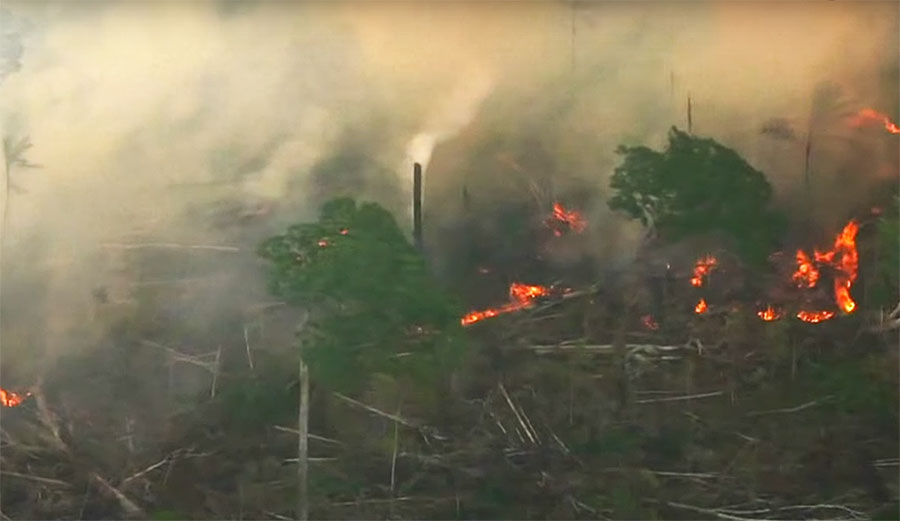
Huge fires are ripping through the Amazon rainforest, an area so large that fighting them is nearly impossible. Photo: Screenshot/BBC

As you read this, the lungs of the planet are on fire. Thousands of fires are scorching the Amazon rainforest, and the media silence surrounding the catastrophe is deafening.
Every year, forest fires light up parts of the Amazon rainforest—they’re a necessary part of a healthy ecosystem, after all. They are a natural cycle of growth and replenishment, clearing dead things from the forest floor, paving the way for new growth and injecting much-needed nutrients into the soil. If you’ve been lucky enough to wander through a charred forest a few months after the fire that tore through it is out, you’ve seen the abundance looking towards the sky; new growth fed by the remains of old stretching tender fingers out of the rich soil towards the sun. And yet, as with everything else, there can be too much of a good thing. The Amazon’s dry season, running from July to October, is the time when the fires are at their peak, but this year, “peak” has been redefined.
According to The National Institute for Space Research (Inpe), satellite data shows an 85 percent increase on the same period in 2018. The BBC reports that more than 75,000 forest fires have been recorded in Brazil in the first eight months of 2019. Throughout the same period last year, only 40,000 were recorded. The fires are so bad, in fact, that in São Paulo, more than 2,000 miles away, the sky is full of smoke.
Good morning. Perhaps, you wanna know what the apocalypse is gonna look like? This was São Paulo, yesterday at 3pm #PrayforAmazonia pic.twitter.com/8uvSlZe1mO
— André Só (@AndreTheSolo) August 20, 2019
As you well know, forest fires are caused by a lot of things — lightning, for one, but more and more frequently they’re caused by farmers clearing the way for crops or grazing land. Since Brazil is one of the world’s largest meat producers, it’s long been an issue, but with Brazilian President Jair Bolsonaro’s tacit encouragement and his administration’s rollbacks of environmental protections, things have ramped up.
Bolsonaro, an outspoken climate change skeptic, has faced heavy international criticism over his handling of the fires. According to Reuters, he has “repeatedly said he believes Brazil should open the Amazon up to business interests, to allow mining, agricultural and logging companies to exploit its natural resources.” In July of 2019, deforestation was 278 percent higher than in July of 2018, according to Inpe.
After saying that Brazil didn’t have the resources to fight the fires, Bolsonaro asked the rest of the world not to help. “These countries that send money here, they don’t send it out of charity,” the right-wing president said in a live broadcast on Thursday, Reuters reported. “They send it with the aim of interfering with our sovereignty.”
Four states have been affected more than most. Roraima, Acre, Rondônia, and Amazonas reported enormous percentage leaps in fires when compared against the years from 2015 to 2018: Roraima saw a 141 percent increase, Acre 138 percent, Rondônia 115 percent, and Amazonas 81 percent. Amazonas, Brazil’s largest state, has declared a state of emergency.
The Amazon is called “the lungs of the planet” for good reason. Its forests suck up millions of tons of carbon emissions every year, but when they’re burned the damage is two-fold. Not only does their ability to absorb carbon emissions disappear, but the carbon they’re storing is released into the atmosphere. According to the Copernicus Atmosphere Monitoring Service (Cams), an Earth observation program from the EU, the fires have released 228 megatonnes of carbon dioxide.
Despite Bolsonaro’s request for the rest of the world to keep their noses out of it, at least a few world leaders are determined not to. “Our house is burning. Literally,” French President Emmanuel Macron tweeted. “The Amazon rain forest – the lungs which produce 20 percent of our planet’s oxygen – is on fire. It is an international crisis. Members of the G7 Summit, let’s discuss this emergency first order in two days!” Unfortunately, Brazil will not be present at the summit.
So what is the most likely outcome of this oddly-quiet disaster? Well, take, for example, a similar disaster in Indonesia that occurred just a few years ago. Back in 2015, tens of thousands of hectares burned throughout Indonesia. Six provinces declared a state of emergency. Dozens of people died and somewhere around half a million people fell ill with respiratory tract infections. Plantation owners were torching entire forests, making room for crops like palm oil.
It happens every year, but 2015 was different. El Niño had robbed the area of much of its annual moisture, and the area was so dry that the earth itself was burning. Peat moss forests, in their undisturbed, flooded state, are naturally fire-resistant, but decades of poor management and forest clearance drained the peat and created a perfect storm for fires that were nearly impossible to put out. National parks burned, killing thousands of animals. Eventually, of course, the rains came and the fires went out.
But now, just a few years later, something that was called “the greatest environmental disaster of the 21st century” has all but disappeared from our memories. Those plantation fires still happen each year, and it’s likely that the Amazon rainforest will suffer a similar fate: a short-lived outrage followed by a complete and total lack of action. Here’s hoping that’s not the case, but history has proven that humans have short memories.

