
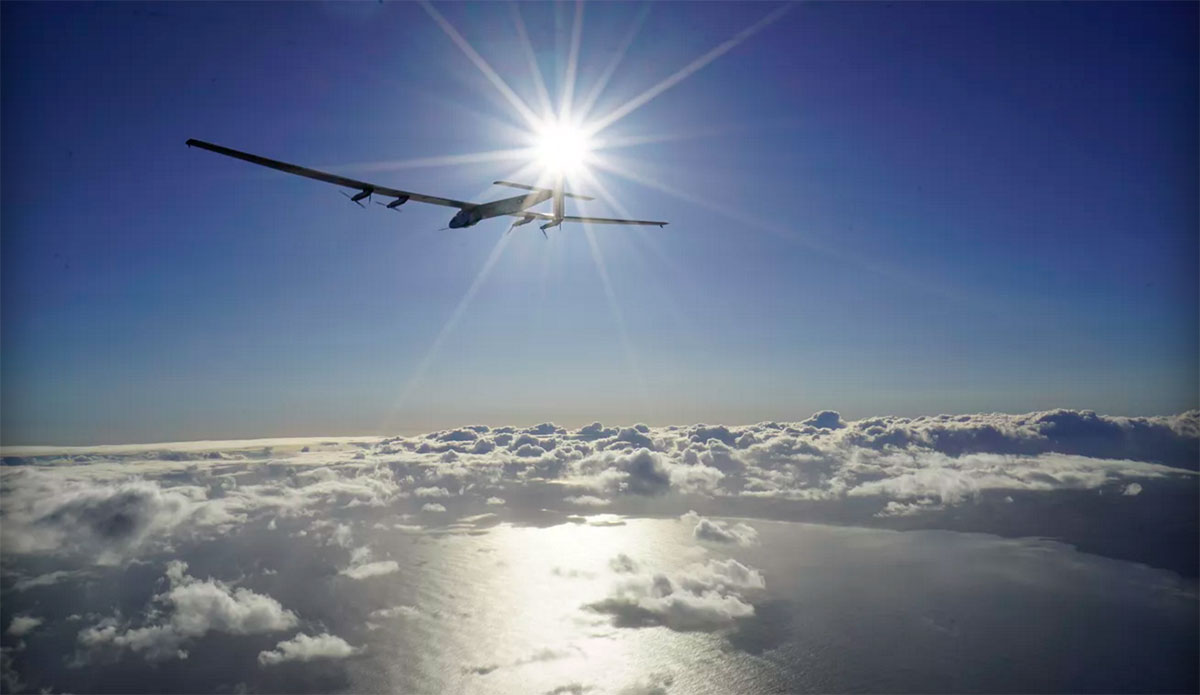
This flight could change the world. Photo: SolarImpulse

It wasn’t all that long ago that a U.S. Air Mail pilot nicknamed Lucky Lindy landed in Le Bourget Field in Paris. Thirty-three hours earlier, he had taken off in Long Island, New York, flying a single-engine, one-person plane. Over the next two days, he flew well over 3000 miles across the open ocean, completing a journey that had never been done before. The year was 1927, and Lucky Lindy, of course, was Charles Lindbergh. The plane was the Spirit of St. Louis, and the flight across the Atlantic became quite possibly the most famous flight since the Wright brothers took off on that beach in North Carolina. And on Thursday, a milestone of nearly the same proportions came to pass: the Solar Impulse 2 crossed the Atlantic using only the sun for power.
Early on Thursday morning, Bertrand Piccard landed the incredible plane in Spain. The Solar Impulse 2 is truly a feat of modern engineering–and it’s one that could change the way we travel forever. With a wingspan of nearly 250 feet, it weighs in at just over 4000 pounds. The Solar Impulse 2 has 17,000 solar cells that charge the plane’s batteries. During the day, the pilot takes the plane to around 30,000 feet, then takes it down to around 5,000 at night to save power.
Last year, Piccard and André Borschberg started their ’round-the-world flight with no fuel in the Solar Impulse 2. The purpose of the flight is two-fold: to prove it can be done, and “to promote the use of renewable energies and energy efficiency on the ground, for a better quality of life.” According to Piccard, it’s the second part of that purpose that’s important. “The goal is not to change aviation, as Charles Lindbergh did,” he said, “but to inspire people to use renewable technologies and show people they can use these technologies every day to have a better quality of life.”
The prototype for the Solar Impulse 2 broke a lot of records–eight, to be exact. It was the first solar powered airplane to fly through the night, the first to fly between two continents, and the first to cross the entire continental United States. With the second version of the plane, Piccard and Borschberg started their journey around the world in Abu Dhabi. From there, the plan was to go to India, Myanmar, China, Japan, U.S.A, and eventually back to Europe and Abu Dhabi, all without any fuel at all. Of course, there has never been anything even remotely close to this attempt, so the pair of pilots faced many obstacles no one had ever dealt with before. The most difficult of which was how to fly across the Pacific for five days and five nights from Japan to Hawaii. In July of 2015, Borschberg completed that 4000 mile flight, and in doing so, he absolutely demolished the record for the longest flight in history. It was 118 hours.
So why is the Atlantic crossing so important? On top of the purely technical achievement, it’s emblematic of human ingenuity. “The Atlantic is the symbolic part of the flight,” said Piccard to the Guardian a few hours before he landed. “It is symbolic because all the means of transportation have always tried to cross the Atlantic: the first steamboats, the first airplane, the first balloons, the first airships and, today, it is the first solar-powered airplane. If an airplane has succeeded to fly day and night without fuel, then we can power our world on clean energy.”
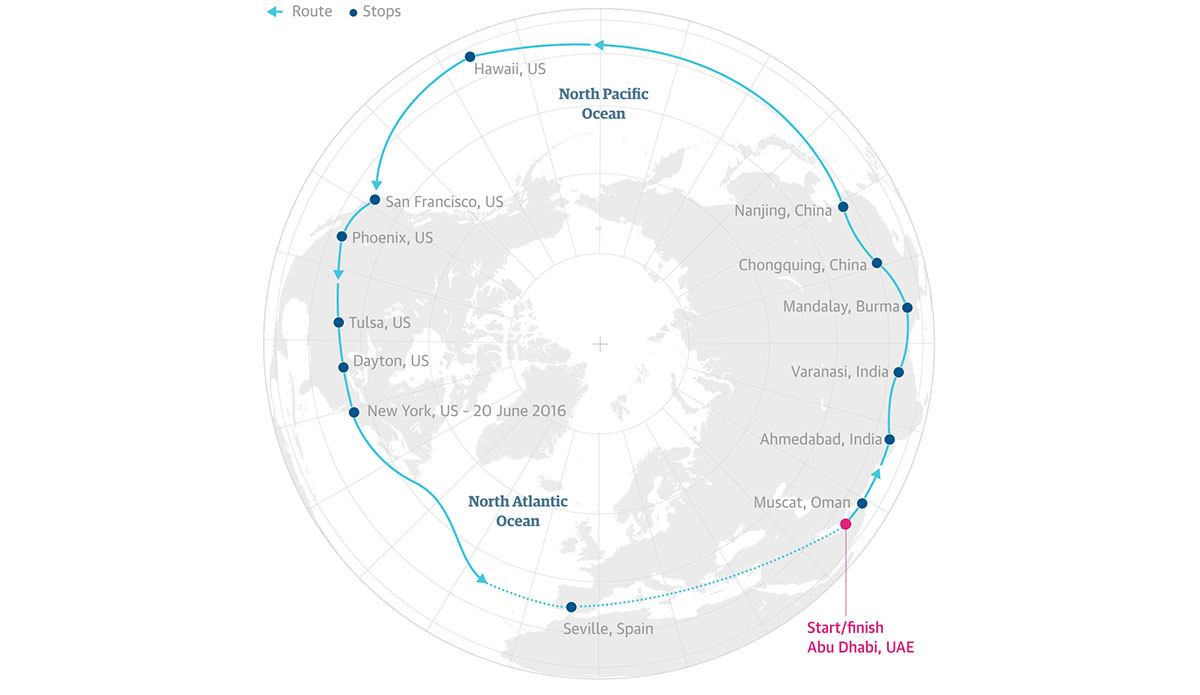
The flight plan for the Solar Impulse 2. Image: The Guardian/SolarImpulse.com
Both Piccard and Borschberg have incredibly interesting life stories. Piccard comes from a long line of adventures, including his father and grandfather. August Piccard, the grandfather was the first man to see the earth’s curvature, and created the building blocks of the aviation industry. He was explored the upper reaches of the stratosphere in a balloon and came up with the idea of the pressurized cabin. Then he decided he’d go the other way, and built a submarine that went deeper than any other before it. That made him not only the man who had been highest but the man who had been deepest, as well. The dive that gave him that record was in 1953, and he, along with his son Jacques, went to 3150 meters.
Jacques, Bertrand’s father, went on from that dive to to become the next man to break the world record for deepest dive. He piloted a submarine to a depth of over 10,000 meters in the Mariana Trench.
Bertrand started off exploring something a little different than his father and grandfather, though: the mind. As a psychiatrist, he specialized in hypnotherapy, then began studying what happens to the human body under extreme situations. That led him into a passion for ballooning–but not just any kind of ballooning. He made the first non-stop flight around the world in one, setting not only the record for the farthest flight ever in aviation history, but the longest in time.
When Piccard and Borschberg finish their incredible journey around the world, it will prove, once again, that there are other options available to fuel our ever-increasing need for energy… we just need to find them.

