
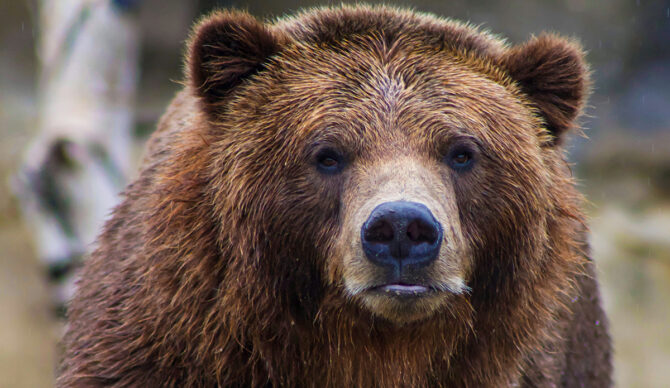
California lawmakers are taking steps to bring the state animal back. Photo: @binkabonka//Unsplash

The official state animal of California, the grizzly bear, hasn’t existed there for over a century. Now, state lawmakers have introduced a new bill that calls for studying the feasibility of bringing grizzlies back to the Golden State and reintegrating them into the ecosystem.
Chris Servheen, who spent 35 years as the U.S. Department of Fish and Wildlife’s grizzly bear recovery coordinator, says the idea is not impossible, but more complicated than it may appear. California’s landscape, he notes, has changed dramatically since grizzlies last roamed the state, and any reintroduction effort would need to account for a wide range of ecological and social constraints.
One of the biggest hurdles to overcome would be California’s isolation from any other grizzly populations, Servheen explains. At its nearest point, California sits several hundred miles away from the closest grizzly populations in the Northern Rocky Mountains. Creating “island” populations — isolated groups disconnected from other groups — cuts off genetic exchange.
“It’s not what you would normally want to do,” Servheen said on a phone call from his home in Missoula, Montana. “You would want to connect bigger populations, so that you have a more robust and resilient group of bears.”
Servheen listed a slew of additional factors to consider, like matching the origin and destination ecosystems, understanding which age and sex of bear is most likely to stay put in the target location, and choosing a time of year to move the animals when food sources are abundant.
He also pointed to the extent of human expansion in California. The 1920 California census was 3.4 million. Since then, the state’s population has exploded more than tenfold, limiting the habitat available for bears.
According to Servheen, grizzlies live far from humans in remote areas where recreation is either low or controlled.
“I like to think of it in terms of the bears having a day off in a place with a lot of people,” Servheen said. “They’re always working to stay away from people, so that’s an important factor (for) getting them to feel comfortable and secure.”
California cattle ranchers have been among the first to oppose the bill. While Servheen acknowledged that grizzly predation on livestock does occur, it’s fairly rare. Grizzlies in the Northern Rockies are omnivores that subsist mainly on plants and insects, and the occasional scavenged animal. And when they do encroach on livestock, management systems relocate or remove the problem bears.
Human risk is another concern, but Servheen said, statistically, the bears pose little danger to humans. Grizzlies account for 1.5 human deaths per year on average in the U.S. However, Californians, who are used to recreating among the state’s tens of thousands of black bears, would have to adapt to the new species. For example, the National Park Service says if a black bear attacks you, do not play dead. But if a grizzly attacks, you should play dead.
Servheen says there are protocols to mitigate risk, such as hiking in groups, making noise, carrying bear spray, and avoiding the morning and evening hours.
“If a grizzly bear knows you’re around, 99.9 percent of the time, they’re going to get out of your way and leave,” he said. “They’re not ambush predators.”
Most grizzly attacks stem from surprise encounters that cause the bear to act defensively, often to protect cubs or food.
“We have literally millions of people mixing it up with thousands of grizzly bears each year, and the number of attacks on people and human fatalities is extremely low,” Servheen said.
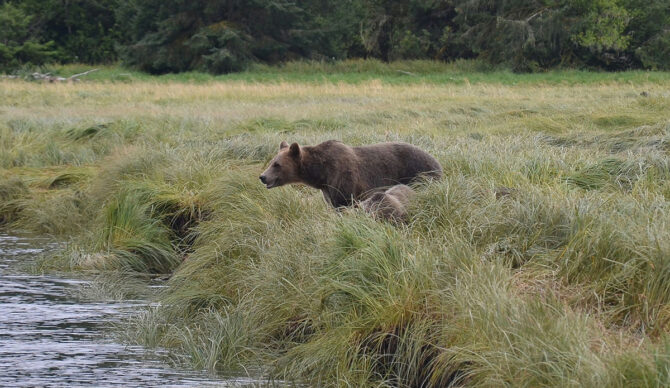
Californians would need to learn how grizzlies differ from the black bears that already populate the state. Photo: Rudi De Meyer//Unsplash
Supporters of reintroduction cite environmental benefits, among other factors, as a key motivation for the bill. In the Northern Rockies, Servheen said that the grizzlies are an important part of the environment, digging up roots and tuber plants, turning over soil, and moving energy from one place to another. Groups in California also note that grizzlies helped spread seeds and nutrients and supplied scavengers with meals.
“Grizzlies are part of the natural environment,” Servheen stressed. “That’s enough of an incentive to have a full complement of the natural animals on the landscape.”
But the ideal scenario can clash with reality. While a 2025 feasibility study determined that California could house around 1,200 grizzly bears, even if the bill passes and subsequent legislation triggers reintroduction, there is still a crucial question: Where would you get grizzlies?
According to Servheen, grizzlies are valued in their current ecosystems. There isn’t a state or country looking to offload a surplus population. He noted that during past reintroduction efforts in Idaho, it was a challenge to find enough suitable bears from nearby mountain ranges. Reintroduction also requires an extensive management system. In the Northern Rockies alone, he estimates roughly 100 people are dedicated to managing grizzlies.
Even with the right ecological conditions, however, Servheen believes reintroduction efforts will fail without support from both the people who share the landscape with the bears and the politicians shaping the legislation. Public buy-in is essential to learning how to coexist with grizzlies, reducing conflict, and increasing the chances of success. He added that past reintroduction efforts have run into political barriers.
“I think that anytime people think about reintroducing species into places where they were, and having a better, more whole ecosystem, that’s good,” Servheen concluded. “I like the idea of thinking big like that, but oftentimes the wish is one thing, and the implementation is another, and I want to stress how complicated it is.”

