
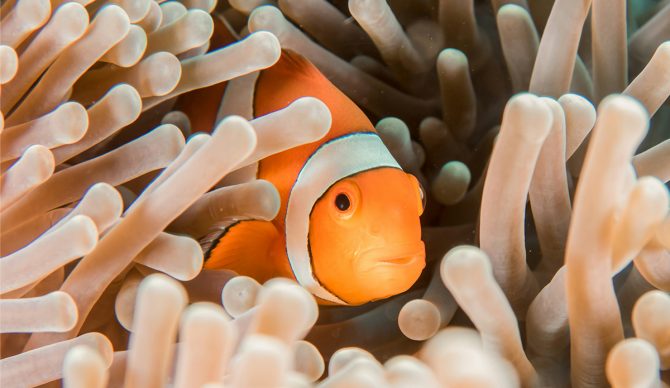
Photo: Sebastian Pena Lambarri // Unsplash

Scientists recently discovered that clownfish can shrink to survive ocean heatwaves. The behavior was observed as part of a study published in the journal Science Advances, where researchers monitored and measured 134 clownfish off the coast of Papa New Guinea.
In 2023, an intense heatwave hit Kimbe Bay. The occurrence was part of a trend of increasingly common ocean heatwaves that have struck around the world as a result of anthropogenic climate change. Over the course of five months, researchers observed that the clownfish in the region appeared to be shrinking in size in order to survive the ordeal.
“We were really shocked at first when we saw that they were shrinking at all,” study author Morgan Bennett-Smith, of Boston University, told the Associated Press.
That’s not the end of it, though. They also found that the amount the fish shrunk depended on their initial size and social rank. Then, when the heatwave passed, they “caught up” and grew back to their original size.
Even more mysteriously, they still don’t quite know exactly how the fish are shrinking (the AP notes that one theory is they may be reabsorbing their own bone matter). It’s also unclear exactly why the reduced size increases their odds of survival so much, although the study authors postulate that it could make it easier to deal with lower oxygen availability or reduce the need for food when it is less plentiful.
In either case, this may be just what the clownfish need to survive in the long term. “This is another tool in the toolbox that fish are going to use to deal with a changing world,” Simon Thorrold, an ocean ecologist at Woods Hole Oceanographic Institution, told Associated Press.

