
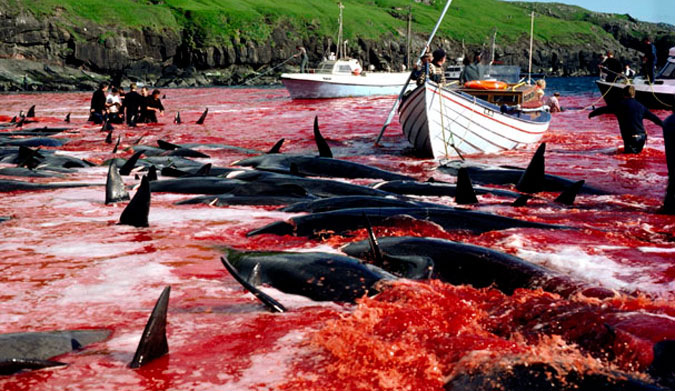
This happens EVERY YEAR. Photo: Advocacy Britannica

Every year, in a remote archipelago sitting in the middle of the North Atlantic, a bloody slaughter takes place. Pilot whales are herded into a bay and killed in a celebration of Norse culture. And last week, it happened again. Sixty-one whales were circled by boats, pushed into a bay and killed, turning the water off Sandavagur Beach on the island of Vagur red with blood.
Known as the grindadráp, the hunt normally occurs between June and September. Whaling has been happening in the Faroes for more than a thousand years; whale meat and blubber was an important part of the residents’ diets. But now, under the guise of maintaining tradition, they’re still doing it… only since the invention of the engine, they’ve been cheating with motorboats.
This particular slaughter is the fifth of the season–a season in which, so far, nearly 500 whales have been killed in three months. The pilot whale slaughter on the Faroe Islands has been a contentious issue for a long time now, and this year is no different. Activist organizations like Sea Shepherd routinely make their presence known every year. This year, however, a different kind of protest is taking place.
Two cruise lines have decided to stop sending their vessels to the Faroe Islands. Hapag-Lloyd and AIDA, two of Germany’s largest cruise companies, aren’t too happy with the whale slaughter, and they’ve decided to hit the island where it hurts: in the pocket.
“Hapag-Lloyd Cruises is committed to treating flora, fauna, and the marine ecosystem as well as all its creatures with respect,” Karl J. Pojer, the company’s chief executive told Take Part. “We protect what fascinates us—it is therefore high in the interests of the company that whaling on the Faroe Islands is stopped.”
Tourism in the area is a big budget affair. Along with fishing, it makes up a large portion of the money coming into the Denmark territory. Each year, cruise ships filled to the brim with fat-walleted tourists line the coffers of the the Faroes, and the island is using the whale hunt to attract them.
“The pilot whale hunt in the Faroes is, by its very nature, a dramatic sight,” the website VisitFaroeIslands.com says. “Entire schools of whales are killed on the shore and in the shallows of bays with knives which are used to sever the major blood supply to the brain.”
Another part of the cruise line’s reasoning behind their boycott is a new law that requires anyone who sees whales to report it to officials.
“Authorities are quoted as saying that these reports can be decisive in determining whether or not the spotted whales are subjected to traditional whaling,” said AIDA’s chief sustainability officer, Monika Griefahn, in an email.
Since the early ’80s, Sea Shepherd has been fighting to put a stop to the grindadráp, but so far, they’ve been unsuccessful. During the most recent hunt, five volunteers were convicted and sentenced to either jail time or fines for trying to stop the hunt.
While AIDA and Hapag-Lloyd aren’t operating in the area, there still others that do. But Sea Shepherd is hoping that this is just start of a movement. “We were very delighted to hear the news,” Rosie Kunneke, land crew leader for Sea Shepherd, told David Kirby for Take Part. “This puts pressure on the cruise industry, who might want to reconsider what people are doing to the animals here.”

