
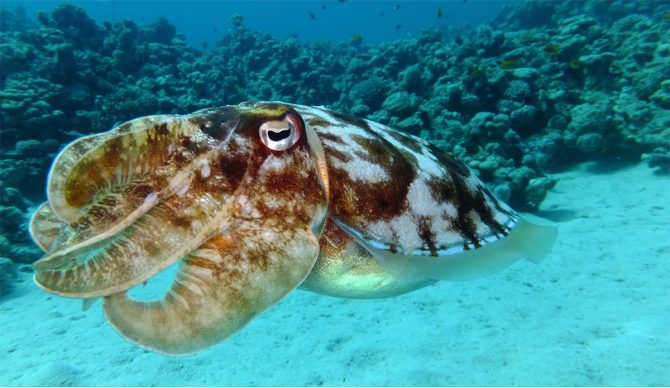
We knew cuttlefish were smart, but they’re like, really smart. Photo: Unsplash

Cuttlefish — and cephalopods in general — are known to be the most intelligent of the invertebrates. They’ve got big old brains and their senses are pretty extraordinary. We know they’re smart, but a study published in 2021 found that they’re even smarter than we thought. Smart enough to pass a cognitive test designed for children.
The test, which was a newer version of something called the Marshmallow Test, attempts to discern an individual’s capacity for delayed gratification, which often corresponds to better life outcomes. In the original version, children were given a marshmallow (or some other kind of treat) and told that if they could wait for 15 minutes before eating it, they’d receive another one and be allowed to eat both. Then they were left alone. In the first follow-up study done a decade later, “preschool children who delayed gratification longer in the self-imposed delay paradigm were described more than 10 years later by their parents as adolescents who were significantly more competent.”
The basic premise is that a child with more ability to delay gratification in anticipation of more gratification in the future would be better at making similar decisions in daily life as they grew older. The researchers doing the study on cuttlefish, of course, didn’t use marshmallows, but crab meat and shrimp.
“Scientists showed that common cuttlefish (Sepia officinalis) can refrain from eating a meal of crab meat in the morning once they have learnt dinner will be something they like much better – shrimp,” wrote ScienceDaily. “However, as a team of researchers led by behavioral ecologist Alexandra Schnell of the University of Cambridge pointed out, in this case it was difficult to determine whether this change in foraging behavior in response to prey availability was also being governed by an ability to exert self-control.”
Realizing they have an issue with the test, the researchers tweaked it slightly. Six cuttlefish were placed in a tank with two closed off areas with transparent doors. One of the areas was then filled with a piece of raw prawn, while the other had live grass shrimp — which the cuttlefish would prefer. The cuttlefish, as smart as they are, were trained to recognize symbols on the doors that corresponded with the time they took to open.
“In the test condition,” ScienceDaily continued, “the prawn was placed behind the open door, while the live shrimp was only accessible after a delay. If the cuttlefish went for the prawn, the shrimp was immediately removed.”
By the end of the study, all the cuttlefish involved had learned to wait for the live shrimp.
“Cuttlefish in the present study were all able to wait for the better reward and tolerated delays for up to 50-130 seconds, which is comparable to what we see in large-brained vertebrates such as chimpanzees, crows, and parrots,” Schnell said in 2021.
The results point to the possibility that cuttlefish can, in a way, plan for the future. It’s just one more indicator of how wildly intelligent cuttlefish really are.

