
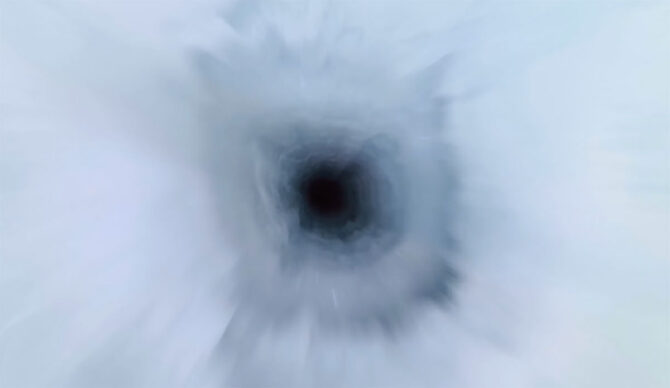
See that? No one has ever seen that before. Photo: YouTube//Screenshot

You’ve likely heard of the “Doomsday Glacier.“ It has a real name — Thwaites Glacier — but that’s less eye-catching than Doomsday Glacier. It is an important slab of ice, though, and a rose by any other name still smells as sweet. It is one of the most volatile ice masses in the world, capable of changing the world as we know it. Which is why researchers at the British Antarctic Survey (BAS) and the Korea Polar Research Institute (KOPRI) decided to drill a 3,300-foot deep hole in it and toss a camera down.
Thwaites Glacier has enough ice in it to raise the global sea level by two to 10 feet, depending on which scientist wrote the paper. It’s absolutely huge, measuring in at around 80 miles wide. For years, researchers have been concerned at the rate it’s melting. Back in 2019, NASA released a report detailing a large cavity that had appeared at the bottom of the Thwaites Glacier. About two-thirds the size of the area of Manhattan and almost 1,000-feet tall, it was a harbinger of the possible fate of the glacier. But the amount of ice that it consists of isn’t the only worry. It also serves as a backstop of sorts for glaciers that sit behind it. Should it melt too much, those could slide into the sea as well.
“Thwaites is the most unstable place in the Antarctic,” said Christine Dow, a glacier expert at the University of Waterloo who co-authored the study, in a press release in 2024. “The worry is that we are underestimating the speed that the glacier is changing, which would be devastating for coastal communities around the world.”
Surprisingly (or not, considering the difficulties), no one had ever been able to measure the temperature of the waters under the glacier. It has been established that they must be considerably warmer than years prior, since the glacier is melting from the bottom, but getting down there was… hard.
The teams used water heated to 176°F to bore a hole in the Doomsday Glacier that was over 3,000 feet deep. One cannot drill a very deep hole without seeing what’s down there, so they dropped a camera down after the hole was drilled. And what they saw was amazing. Countless layers of ice and strange pockets that look like ice caves flew by as the camera went deeper.
The mission as a whole, however, failed. It failed because West Antarctica is a hostile place. The glacier shifts up to 30 feet a day, so the borehole didn’t remain vertical. The hole was constantly freezing over at various depths. And finally, the research vessel that was their ride home, needed to leave because the weather forecast was just too awful. But although the mission was cut short, the footage they got is stunning.
This isn’t the end of the attempts, and researchers are already planning to return. “Failure is always an option when you are pushing at the limits of scientific exploration,” said Peter Davis, BAS oceanographer and member of the drilling team. “We know heat beneath Thwaites Glacier is driving ice loss. These observations are an important step forward, even though we are disappointed the full deployment could not be achieved.”

