
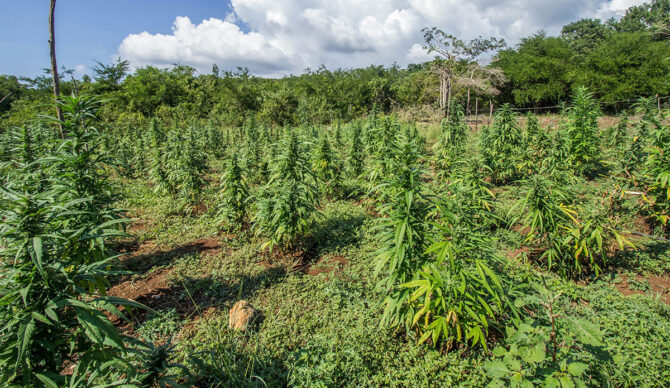
More than a decade after marijuana was legalized in California, experts say illegal grow sites are still harming the environment. Photo: Jay Stonne//Upsplash

Pot has been legal in California for a decade, but a sprawling black market persists for crops cultivated outside the law. In a February 9 report from CalMatters, environmentalists and politicians sounded the alarm regarding the challenges they face in mitigating environmental damage caused by illegal marijuana farms.
“It’s like whack-a-mole,” said Scott Bauer, an environmental program manager with the Department of Fish and Wildlife’s cannabis office. “(Illegal farms) pop up in a new location, and then we have to go there – but the impacts are occurring across the landscape.”
According to ecologist Greta Wengert, the primary threats these illicit grows pose to the environment include pesticides, fertilizers, trash, and expansive webs of irrigation tubing. Wengert has identified roughly 7,000 illegal grows on California’s public lands – a figure she considers an underestimate – yet she knows of only 587 sites that have been at least partially cleaned up.
The California Department of Fish and Wildlife’s 2021 report on illicit cannabis grows detailed the eradication of 2.6 million plants weighing a total of 487,270 pounds. During these operations, officials seized 794 firearms and removed 32,230 pounds of trash.
Wengert is the co-founder of the Integral Ecology Research Center, a non-profit that conducts scientific research into the environmental impacts of cannabis cultivation on public lands. Her team was recently granted a $5.3 million state budget through the Cannabis Restoration Grant Program to study these grows and formulate a comprehensive cleanup strategy.
“(The pesticide containers are) just these little death bombs, waiting for any wildlife that is going to investigate,” said Wengert, who added that she’s found carcasses of animals that fed on the pesticides so toxic that even the flies that feast on the body die.
Several factors complicate the cleanup of these illegal farms, including inadequate funding, understaffing, and the fact that many sites are located on private land. These obstacles have made restoration a daunting challenge.
However, fees and taxes from the legal cannabis market have begun to support these efforts. Over the past decade, the California Department of Fish and Wildlife has removed 350,000 pounds of trash and 920 pesticide containers thanks to this revenue.
Former California Assemblymember Jim Wood, who left office in 2024, highlighted before his departure that insufficient action was being taken to address these sites.
“Everybody thought with legalization that a lot of these problems would go away,” said Wood. “(But) it’s a ticking environmental time bomb.”

