
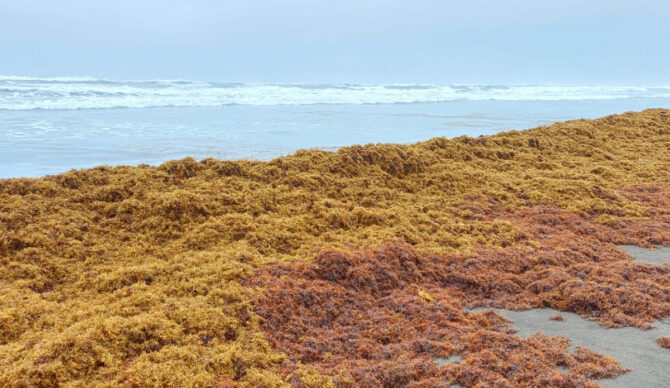
Sargassum can wind up on beaches in enormous heaps, and in 2026, those heaps are predicted to be even bigger. Photo: Wikimedia Commons

For Florida residents and visitors alike, sargassum season can be a stinking mess. This year, it’s likely to be even messier and stinkier than ever before. According to reports, it’s estimated that the Great Atlantic Sargassum Belt will produce more than 37.5 million tons of the stuff in 2026.
Sargassum is a kind of seaweed. It’s a brown-ish algae that forms enormous mats on the open ocean, and when the wind and currents decide to, they can deposit those mats on coastlines. Sargassum is interesting stuff. Unlike regular seaweeds, it isn’t attached to the seabed. It floats around getting everything it needs without roots, but in the last few decades a few things have turned those floating, slimy mats into a beast. Nutrient rich runoff, warming oceans, and shifting currents are all helping it along, and that’s not a great thing.
In the North Atlantic, there’s an area known as the Sargassum Sea. It’s about two-million square miles, and, as the name implies, it’s home to a vast amount of the stuff. But oddly strong winds and weird weather are making it likely, according to the University of South Florida, that there will be “record-high Sargassum amount in most regions.”
The last few years have consistently been record breakers in the sargassum world. “Twenty-eighteen was our big, eye-opening growth moment,” oceanographer and sargassum expert Dr. Tracy Fanara told Weather.com. “I think we got up to 20 million tons. And then last year, it broke records again at 38 million tons, if I recall correctly. And this year we’re on track at this rate to beat that.”
While sargassum isn’t necessarily bad, too much of anything can be a real pain in the butt, especially for a place that’s reliant on tourism, like Florida. Huge piles of sargassum on beaches not only stinks to high heaven, but it attracts sea lice, accumulates toxins, and can even contain flesh-eating bacteria.
“Thanks to its chemical composition, sargassum loses much of its usefulness once it washes up along shore. As it starts to decay, the biomass releases large amounts of hydrogen sulfide gas infamous for its ‘rotten egg’ smell,” wrote PopSci.com. “Exposure to large amounts of the stinky plant life often causes throat, nose, and eye irritation, but the problems are much more severe for other nearby creatures. Too much sargassum on a beach can prevent sea turtles from nesting, and make it difficult for those that do hatch to make it back out to the ocean. Especially dense piles of the stuff also blocks sunlight and prevents native plants from germinating.”
It’s a tough thing to tackle because it isn’t easy to pinpoint what’s causing the uptick in sargassum. “We can’t blame the record high levels of sargassum on just one thing,” Fanara explained. “It’s a number of different ecological factors and physical factors that results in an event like this.”
But one thing is for sure: some Florida beaches are going to get stinky this summer.

