
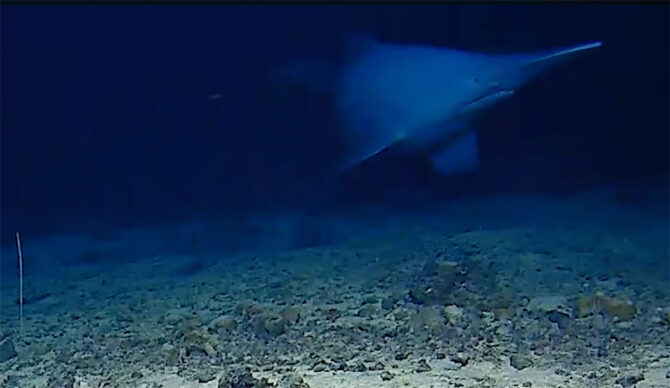
Goblin sharks are incredibly elusive and live in the deepest reaches of the ocean. Photo: E/V Nautilus

The goblin shark is one of those creatures we know exists, but only because we’ve hauled them up from the depths by accident. Some have been placed in tanks to see what behaviors they exhibit, but that’s not the greatest way to learn what an animal does in its natural habitat. But now, researchers have some real footage to study.
You’ve likely seen images of a goblin shark before — known to science-minded folks as Mitsukurina owstoni — and they’re not the prettiest creature in the sea. They’re the ones with the long, pointed nose and the jaws that can shoot out when hunting. From a human’s perspective, they’re absolutely hideous. That hideousness, however, has a purpose.
“Life is very different in the deep sea, and the goblin shark’s unique aesthetic is a reflection of that,” writes IFLScience. “With the fastest jaws in the ocean (or, at least, of its sharks), it can project its gnashers out of its face, firing like a slingshot that extends between 8.6-9.4 percent of its total body length. This means it can snatch prey that would have otherwise been just out of reach.”
The goblin shark was first discovere in 1898 off the coast of Japan. They’re pretty well distributed around the world, living in the Atlantic, Indian and Pacific Oceans, way down deep in the inky depths called the benthopelagic zone, which is basically the bottom of any body of water. Since they live in the ocean’s benthopelagic zone, they’re deep. Even deeper than anyone knew.
That, of course, makes them hard to study because we’re not super well acclimated to life at the bottom of the sea. But with the help of a remotely operated vehicle called Hercules, researchers were able to film one in 2019 at a little over 4,000 feet near Jarvis Island in the Central Pacific Ocean.
“It was a solitary male around 3.43 meters long and, using growth parameter estimates, which the researchers state are somewhat speculative, likely in the region of 51.5 years old,” IFLScience continued. “The second sighting occurred on the slope of the Tonga Trench in 2024. This observation extended the known depth range of M. owstoni by 697 meters (2,287 feet), from the previous known maximum of 1,300 meters (4,265 feet). The imagery wasn’t perfect but the scientists couldn’t spot any sign of claspers – specialized fin-like protrusions that help males to mate – so they believe this individual was a female.”
For researchers, seeing goblin sharks in their natural habitat is a real boon.
“These observations increase its geographic range further into the Pacific, and its vertical depth range by 697 meters,” researchers wrote in the journal Fish Biology. “This work also confirms in situ habitat use of a Central Pacific seamount, and near-trench slope habitats in the Western Pacific. Amidst global impacts on chondrichthyans, and increasing anthropogenic risks to deep-sea species, further solidification of biogeographic ranges and habitat preferences is helpful for informing conservation management, especially for species with intrinsically vulnerable life histories such as M. owstoni.”

