
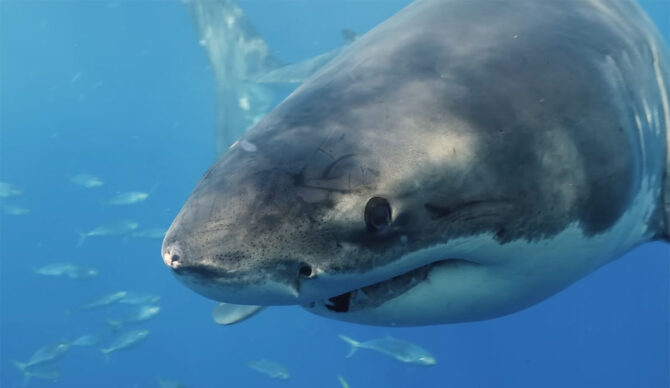
“Ya know the thing about a shark, he’s got lifeless eyes. Black eyes, like a doll’s eyes. When he comes at ya, he doesn’t seem to be livin’… until he bites ya.” Photo: YouTube//Screenshot

Great white sharks scare a lot of people. Hell, they should scare a lot of people because they evolved to be perfect hunters. They are not, however, man-eating beasts hellbent on devouring our flesh. But given movies like Jaws and the outsized effect it had on the public’s perception of great whites, you would be forgiven if you felt a little leery about them. In Australia especially, shark attacks are a little more top of mind for a few reasons: there are lots of people in the water and there are lots of sharks. But are great white sharks really more aggressive in the Land Down Under than they are in California? That’s the question shark researcher Carlos Gauna seeks to answer in his latest YouTube offering.
“This video looks beyond headlines and viral clips to examine why shark encounters in different parts of the world can appear so different,” Gauna wrote. “Using long-term field observations along the Southern California coast and publicly available incident data, I explore whether these differences reflect shark behavior — or the conditions surrounding each encounter.”
When it comes to shark attacks, it’s easy to miss the forest for the trees. A single bite can be incredibly devastating, even if that single bite was likely just a test bite or a case of mistaken identity. Instead of studying a single tree, Gauna studied the forest.
“Rather than focusing on individual incidents, this analysis considers how geography, water clarity, prey overlap, emergency response time, and human activity shape outcomes when people and great white sharks cross paths,” Gauna continued. “This is not about minimizing real harm or taking sides. It’s about understanding how the same species can produce very different results under different circumstances—and why context matters when interpreting shark encounters.”

