
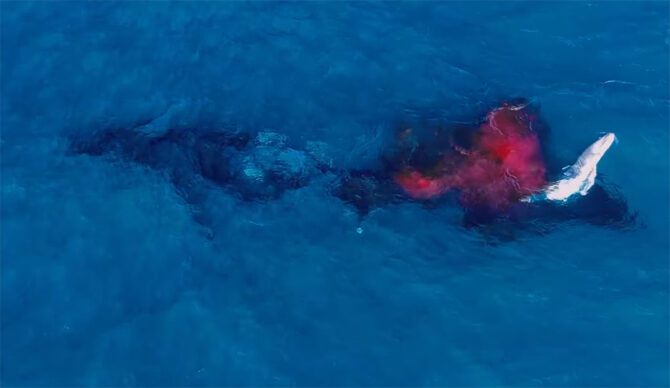
A humpback whale birth has only been recorded three times, and never from a drone. Photo: YouTube//Screenshot

For all of our research and observations of the natural world, there is still so much we don’t know about it and its many creatures. But on July 28, researchers were privy to something that’s only been seen three times before: the birth of a humpback whale.
Each year, humpbacks make the long migration around Australia’s east coast from Antarctica, where they spend a few months eating as much as possible. Once they move on to warmer waters, they begin to welcome their calves into the world. Alexander Forrest, a drone operator, was filming that migration when he caught the rare footage.
“I had just changed my drone battery when the whale surfaced, and hit record just in time – every surface presents a unique behavior,” he told IFL Science. “Moments later, a large plume of blood appeared. I was relieved to see a newborn calf rising to the surface for its first breath, and not a predator interaction.”
What happened next worried Forrest for a short time, but he soon realized it was just a mother being a mother.
“For perhaps five seconds after the birth, the mother remained completely still whilst the calf floated at the surface,” he remembered. “She then instinctually turned back into murky-bloodied water to reunite with her newborn.”
Forrest, who was one of three drone operators on scene from the Organization for the Rescue and Research of Cetaceans in Australia (ORRCA), filmed for several more hours, and they suspect that the footage they captured was the first of its kind.
“They managed to record the first few hours of the calf’s life from the drones, showing the mother’s nurturing behavior, the newborn’s first dives,” IFL Science wrote, “and even interactions with several other humpback whales that came to check out the newborn.”
It’s not just heart-warming and rare footage, either. It’s incredibly useful to the scientific community, as well. Seeing how a humpback whale behaves after its been born or after it has just given birth will help us to further understand these amazing animals.
“To date, there are three other published observations of humpback whale births worldwide, with a preliminary review identifying this birth as the first to be captured from the air. Being able to document this event in such detail makes it an incredibly important scientific observation,” said ORRCA Head of Research Annie Post in a statement. “It is an extraordinary contribution to our understanding of humpback whale reproduction and maternal behavior.”

