
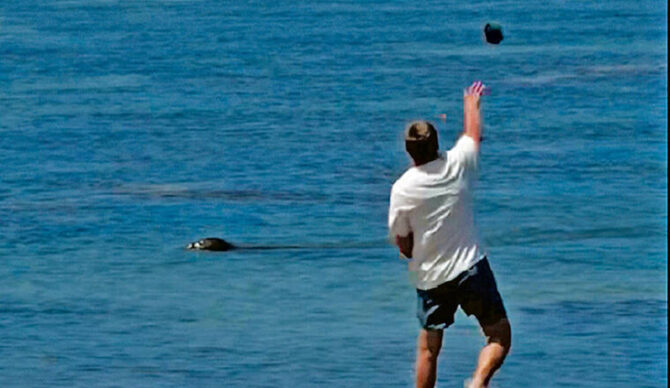
Lytvynchuk has been threatened, doxed, and even received a package full of feces after throwing rocks at a seal on Maui. Photo: Screenshot

Igor Lytvynchuk, the Maui tourist who was caught on camera chucking a rock at a Hawaiian monk seal, is in seriously hot water. Legal issues aside, his defense attorney says that he has been physically assaulted, threatened, and doxed. The doxing came, according to Lytvnchuk’s attorney, with a box of poop. Doxed, for those unaware, is “the malicious public release of an individual’s private or identifying information online without their consent.”
In early May, the 38-year-old Lytvynchuk was filmed throwing rocks at a monk seal that frequents the waters off Lahaina. Scientists identified the seal as an adult male known as “R404.” The public immediately leapt into action, attempting to name and shame him. At the time, his name was not made public. Within hours, another video surfaced of Lytvynchuk catching cracks from an unknown local. When Lytvynchuk was arrested and charged, his name hit the news and all bets were off.
Lytvynchuk, who hails from Covington, Washington, is heading to U.S. District Court in Honolulu Wednesday on charges of harassing and attempting to harass a protected animal. His defense? He was trying to protect the turtles.
“There were two large turtles in the water. When he threw the rock, the intention was to scare the seal away. He had no idea, again, the significance of monk seals. He frankly didn’t know we had seals in Hawaii,” Breiner told Hawaii media.“He assumed that when he saw the seal, the monk seal, pushing the turtles off of the rocks, that he was doing something good by scaring it away.”
The public, however, isn’t buying it. According to Lytvynchuk’s laywer, he has “faced death threats and doxing, including receiving a package at his home containing what appeared to be feces.”
Hawaiian monk seals are critically endangered, with only 1,600 left in the wild. If Lytvynchuk is convicted of violations of the Endangered Species Act and the Marine Mammal Protection Act, he faces up to one year in prison for each charge, as well as a fine of up to $50,000 under the Endangered Species Act and a fine of up to $20,000 under the Marine Mammal Protection Act.

