
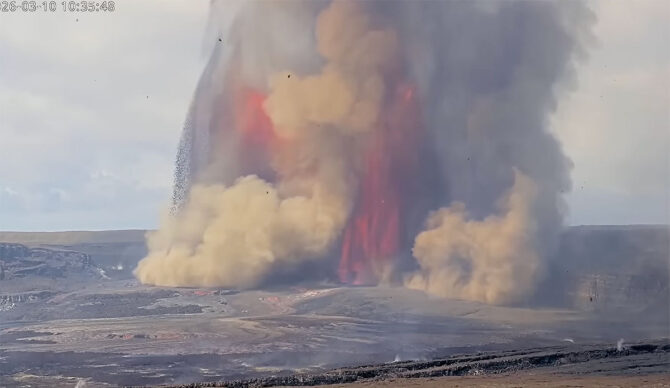
When the volcano erupts here, don’t be there. Photo: USGS

Parts of Hawaii Volcanoes National Park are not safe places to be these days. A massive eruption at Kilauea paused on Tuesday evening, but not before it prompted officials to issue a warning because tephra began falling into nearby communities.
Tephra is basically just a blanket term for all the stuff that gets flung out of a volcano when its erupting. From football-sized chunks of rock to tiny ash particles, tephra can be responsible for everything from caved-in roofs to scratchy throats.
The eruption you see here lasted for about nine hours. Despite the fact that Kilauea has been active for years now, the sheer power of its eruptions don’t get old. The USGS has a few live-streaming cameras posted up there, and every now and then we’re treated to a sight like the one you see in the video here. After the eruption slowed, it was an eerie place.
“Lava flows remained incandescent and continued to spread across the floor of Halemaʻumaʻu crater covering another 5-10 percent along the southeastern margin of the crater,” the USGS wrote. “Incandescence dimmed and flows slowed significantly in the early morning hours. Lava emplaced around and above the vents continued to creep downslope into the crater but also slowed in the early morning hours. Incandescence on the crater floor may remain for several days and flows around the vent will likely continue to move downslope during this time.”

