
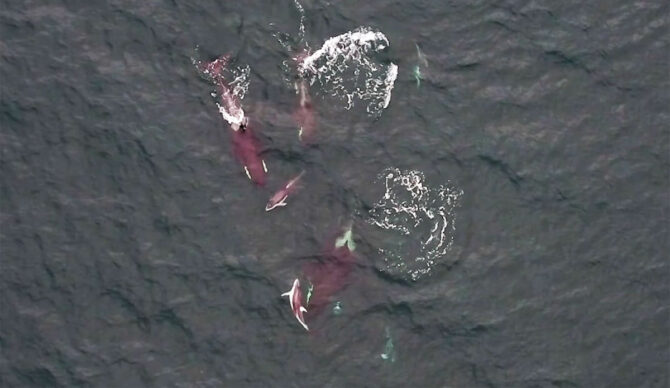
Stronger together, right? Photo: Screenshot

Killer whales and dolphins have, for the first time ever, been observed hunting together. Both species rely heavily on salmon that live in the waters off the British Columbia coastline, but until now, they’d never been filmed teaming up.
The killer whales are a specific species called northern resident killer whales — which don’t have quite the extinction threat as the southern residents — and the dolphins are Pacific white sided dolphins. Although they do both compete for salmon, they’re often seen hunting near each other, but never together.
“Typically you’d expect to see some signs of conflict when two predatory species share territory, and yet nobody’s ever seen them fighting or avoiding each other,” IFLScience wrote. “It got scientists wondering if, in fact, they might be in cahoots.”
Like all good scientists, they decided to find an answer to their own question. They began tracking the killer whales while keeping an eye peeled for any times they might be hanging around near the dolphins. They started looking in 2020 off the coast of Vancouver Island, a place where killer whales and dolphins can be seen with relative frequency. Using everything from acoustic data and aerial footage to underwater footage and cameras strapped directly to the killer whales, they were able to collect an extraordinary amount of data.
When they pored over it all, they found 25 killer whale-dolphin interactions where the killer whales apparently saw what the dolphins were doing and changed course to follow along with them. They also were observed going on “foraging dives” together.
“Our data suggest that interspecific cooperative foraging offers ecological advantages to both species, particularly during seasonal Chinook salmon migrations when prey is more concentrated but also more evasive,” wrote the authors of a study published in Nature. “Whether this behavioral pattern persists during other seasons or in the absence of high-value prey remains an open question and warrants further investigation.”

