

The ocean is in hot water. Literally. Photos: Unsplash//NOAA

If you’re a person who follows climate news, you likely remember something called “the Blob.” It’s a massive marine heat wave, and it’s back. This time, it’s even bigger.
According to reports, the 2025 version of the Blob stretches nearly 5,000 miles from Japan to the West Coast of the United States. As the name suggests, it’s a blob of strangely warm ocean water, which has global effects on weather patterns and marine life. Higher ocean water heat means more evaporation and more rainfall. It can enhance the strength of atmospheric rivers, and has a huge impact on snowfall in the mountains.
In August, the sea surface temperature across the entirety of the North Pacific Ocean absolutely smashed records that date back to the late 1800s. Although the occurrence is part of a relatively common marine heat wave pattern, the O.G. Blob that made the world sit up and take notice happened in the years between 2013 and 2016.
This new one, however, is much larger. “The entire North Pacific Ocean Basin is involved in the current marine heat wave, standing out starkly on weather maps,” CNN reported. “This event is unique for its intensity and extraordinary geographic reach, and for its potential to eventually alter large-scale weather patterns if it continues.”
If the blob persists — which it very likely will — it’s going to influence wintertime storms that are associated with the jet stream. Animals are pretty severely affected by it too, especially seabirds like common murres. The original blob wreaked havoc on that population in Alaska, and they’re still recovering from it.
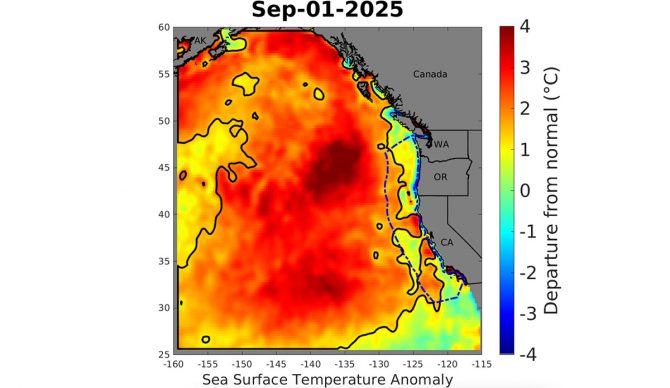
The Blob, as shown in temperature data from NOAA. Image: NOAA
“There have been multiple die-offs of marine mammals, seabirds and forage fish in Alaskan waters this summer; we have definitely had an uptick in calls from the public about sick and dead birds,” said Heather Renner, supervisory wildlife biologist at the Alaska Maritime National Wildlife Refuge, to CNN. “These have all been much smaller than what was seen in 2015-2016 but have affected a wide variety of species.”
So far, though, the current blob hasn’t been around long enough to have wide-ranging effects on wildlife, but as of this writing, NOAA has it listed as the fourth-largest Northeast Pacific blob yet observed.
Hopefully, the stronger and cooler winds that generally come with autumn and winter will be enough to churn the deeper, cooler waters up and dampen the blob’s strength.
“Since this is a summer anomaly, it is very likely confined to a very thin mixed layer depth,” said Art Miller, an oceanographer at the Scripps Institution of Oceanography. “So once the atmospheric conditions change, it should fade quickly into the ocean via vertical mixing and through losing heat to the atmosphere.”
As you likely expected, the cause of the latest marine heatwave is attached to the changing climate. “There is concern,” Miller continued, “that because these anomalies are happening with similar (but not exactly the same) structures that the persistent atmospheric pressure patterns might be part of an adjustment of the Pacific Ocean climate state to global warming conditions driven by greenhouse gases from fossil fuel burning.”
Researchers are worried that the persisting pattern of worsening marine heatwaves will make things difficult for every living creature down the line.
“The North Pacific has a fever, but the story doesn’t end there,” Miller said. “The downstream effects of these marine heatwaves is likely to be significant in terms of how they impact marine organisms, ecosystem structure, fisheries, and the weather in the Pacific Northwest. Stay tuned.”

