
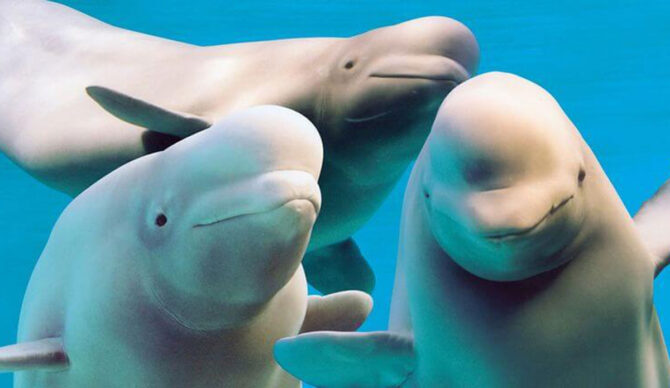
Marineland has reissued the threat of euthanizing beluga whales and dolphins if they aren’t allowed to sell them to other parks. Photo: The Whale Sanctuary Project

Marineland, the shuttered amusement park in Ontario, Canada, had an advertisement that ran through the ’90s. The jingle that went along with it was a real brain worm, and all these years later it’s still stuck in my head. “Everyone looooves Marineland,” it jingled. But everyone does not love Marineland anymore. CBC reported that a team from the amusement park met with Joanne Thompson, Minister of Fisheries, Oceans and the Canadian Coast Guard and let her know that if the federal government didn’t approve export permits to move 30 of Marineland’s beluga whales and four dolphins abroad, they would move ahead with their plan to euthanize them.
The whole thing started after Marineland closed its doors to the public. That meant that it would need to figure out something to do with the animals that call the place home, including the aforementioned beluga whales. Marineland doesn’t have the greatest track record when it comes to animal welfare.
“At time of this posting, there remain 30 beluga whales at Marineland Canada,” wrote The Whale Sanctuary Project. “Over the years a total of 88 belugas have spent all or part of their lives at the now-shuttered theme park. Of those 88, 36 were captured from the ocean off the east coast of Russia; the other 52 are their children or grandchildren. Of the 36 who were captured from the ocean, 15 are still alive. The oldest is probably Gemini, captured in 1999. Of the 52 who have never known life outside of a concrete tank, 15 are also still alive. The oldest, Jellybean, is about 18 years old; the youngest, Rain, was born in 2019, just as the Canadian government was passing the Ending the Captivity of Whales & Dolphins Act, which bans further breeding of captive whales and dolphins.”
According to a database created by The Canadian Press, 20 whales — an orca and 19 belugas — have died at the Niagara Falls, Ontario, tourist attraction since 2019. When the place closed up, it wanted to send some of its whales to Chimelong Ocean Kingdom in China, but the Canadian government said no because that would likely mean they’d be sent to another awful little park where the animals would be stuck in tiny pools and forced to dance around for fish scraps while humans ogled them. That refusal, however, left Marineland in a bit of a bind: without any income from park visitors, there wasn’t enough money to care for the whales.
“I could not in good conscience approve an export that would perpetuate the treatment these belugas have endured,” said Thompson at the time. “To approve the request would have meant a continued life in captivity and a return to public entertainment.”
Next, Marineland requested some cash to help keep the animals’ living standards up, but that too was denied because Thompson was of the opinion that Marinland’s issue shouldn’t mean the Canadian government should have to shell out for the whales’ care. That’s when the first threat to kill the animals arose.
In recent days, however, Marineland ditched the China request and asked to move the whales and a few dolphins to Georgia Aquarium, Mystic Aquarium, Shedd Aquarium, and an undisclosed SeaWorld location. It was at that meeting that “Marineland gave the federal government an ‘imminent’ deadline to approve the permits, saying it would move forward with a plan it already has in place to euthanize the whales if the deadline is not met.”
None of the aquariums officially confirmed the plan to accept the animals, but two of them did release statements that at least confirm it’s a possibility.
“To be clear, it’s premature for any U.S.-based facilities to formally commit to taking in the Marineland belugas,” Jennifer Sherman, Mystic Aquarium’s vice-president of marketing, wrote in an email to CBC News. “The focus at this stage must be on the animals themselves.”
For now, the deadline hasn’t arrived, and Thompson’s office will review the request to move the whales and dolphins instead of killing them. Animal rights groups keeping a close eye on the developments are adamant that the whales don’t go somewhere where they will be bred or exploited, but that might be a tough place to find.
“This is not simply about where the whales go,” said Camille Labchuk, executive director of Animal Justice, an organization that makes sure that animals have a legal voice in Canada. “It is about the quality of their lives once they leave Canada, and ensuring U.S. facilities respect our laws that prohibit breeding or exploiting these whales and dolphins in performances.”

