
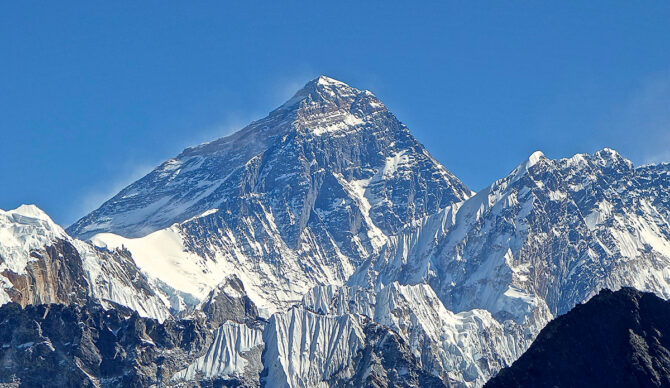
Pack your trash, Everest climbers. Photo: Wikimedia Commons

We humans are pretty good at leaving our trash all over the place. From the deepest reaches of the ocean to the highest points on Earth, our castoffs have made their way into every nook, cranny, recess, niche, alcove, cubbyhole, opening, and any other word that shows up when I Google “synonym for nook.” One of the places that’s pretty famous for its beauty, majesty, impossibility, and the sheer amount of garbage on its upper reaches is Mount Everest. Since the 1980s, Nepalese authorities have been attempting to deal with it, but they’ve recently announced that they will be changing tack.
A few years ago, Nepal made it a requirement for Everest summit hopefuls to pack their trash. Eighteen pounds of it, to be exact. It’s estimated that there are around 50 tons of trash littered all over the world’s highest peak, so climbers were required to take garbage back down the mountain — theirs or not, it didn’t matter — or give up a $4,000 deposit. Authorities were hopeful that the camp on South Col in particular would look a little more pristine and a little less garbage dumpy, but it looks as though $4,000 was an acceptable price to pay for doing the downclimb unencumbered. Either that or the climbers would simply take 18 pounds of garbage from a lower camp, where the issue isn’t quite so glaring.
“From higher camps, people tend to bring back oxygen bottles only,” said Tshering Sherpa, chief executive officer of the Sagarmatha Pollution Control Committee, to the BBC. “Other things like tents and cans and boxes of packed foods and drinks are mostly left behind there, that is why we can see so much waste piling up.”
There is one huge fault in the 18 pounds rule: on average, an Everest climber will produce about 26 pounds of waste on the mountain over the six-or-so weeks it takes to get from bottom to top and back again. That, if my math is correct, is eight pounds more than the requirement (not to mention the decades worth of detritus that was already up there), so it makes sense that the problem hasn’t gone away. Add to that the fact that no one’s really monitoring what’s going on at the higher points, and you’ve got a thin-aired trash dump that draws a lot of tourists, all of whom have more trash to contribute to the dump.
“Apart from the check point above the Khumbu Icefall,” Mr. Sherpa explained, “there is no monitoring of what climbers are doing.”
Moving forward, things are going to change in hopes that a different plan will actually do something to mitigate the mounting issue. Climbers will be required to pay a non-refundable clean-up fee that will be used, according to reports, to create a checkpoint at Camp 2, as well as paying rangers to monitor the higher parts of the mountain to ensure the climbers are bringing down what they’ve brought up.
The BBC reported that “Tourism ministry officials said it will most probably be $4,000 per climber – the same amount as deposit money – and will come into effect once passed by the parliament.” This is good news to the locals and anyone who cares about the state of the world’s most famous peak.
“We had been questioning the effectiveness of the deposit scheme all this time because we are not aware of anyone who was penalized for not bringing their trash down,” said Mingma Sherpa, chairperson of the Pasang Lhamu rural municipality. “And there was no designated fund but now this non-refundable fee will lead to creation of a fund that can enable us to do all these clean-up and monitoring works.”

