
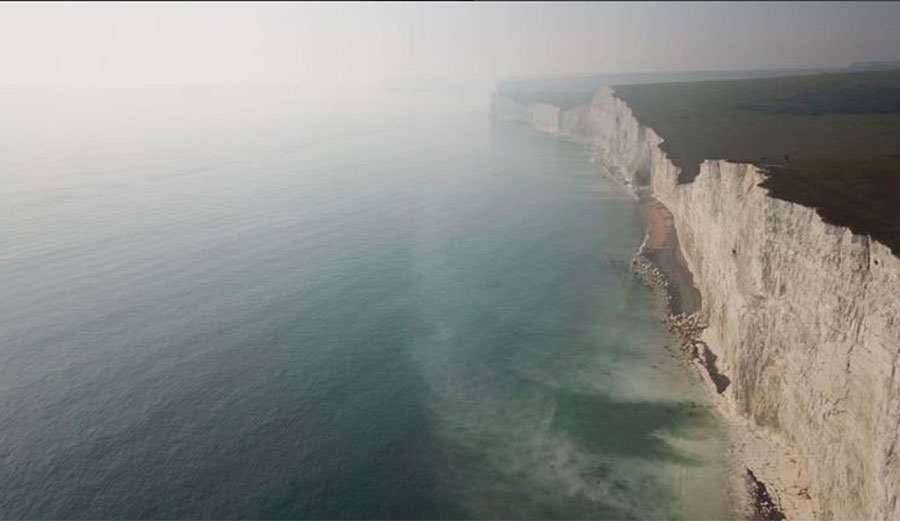
The fog hit English beaches on Sunday, sending over 100 people to the hospital. Image: Twitter/ Darren Oatway

A few days ago, a strange thing happened to beachgoers in East Sussex. As they sat sunning their English bodies in the weak English sun, a mist rolled over the ocean towards them. At first, since this is England, after all, everyone assumed it was just plain old boring fog. When it hit them, however, it quickly became apparent that it was not–victims suffered from burning eyes, coughing fits, sore throats, and vomiting. One hundred and thirty-three people went to the hospital, and authorities soon released a directive for residents in the area to stay inside and keep their windows closed.
Years and years ago, I was on Hawaii’s Big Island for some reason or another. It was Pahoa, I think, and there was the best little movie theatre on earth. They played old movies for a buck in the afternoons, and there is no place to escape the anguish of a hangover like a movie theatre. One afternoon, we settled in with our $10 popcorn (they have to make their money somewhere) and watched a wonderfully bad movie from 1980 called The Fog. In it, an eerie green fog swept over a California town, bringing the angry ghosts of sailors from a 100-year-old shipwreck. It was fucking terrible, and I loved it. Unfortunately, both for East Sussex bathers and for me, the English fog didn’t bring ghost pirates. It just made people throw up.
Authorities still have no idea where the fog came from, although a few experts have put forth a couple of theories, including accidental chemical discharges from a nearby water treatment plant and toxins from the year’s abnormally large algal blooms.
“From my experience in regulating water companies, unplanned discharges are not uncommon,” David Slater of the school of engineering at Cardiff University told The Guardian. Slater’s theory is backed up by numerous reports from people that the fog smelled vaguely of chlorine gas, although a representative from Southern Water, the treatment plant nearby, denied it. All our sites in the area are constantly monitored and everything is working normally,” the spokeswoman told The Guardian. She also said that chlorine was not among the chemicals used at the plant.
Birling Gap beach evacuated after suspected chemical leak #BirlingGap #Birling pic.twitter.com/1UjrGu56Ws
— Darren Oatway (@DarrenOatway) August 27, 2017
Now, a few days later, the fog has disappeared, but the mystery remains. A professor from Southhampton University had an alternate theory, although he did admit that it wasn’t very likely. He posits that the cloud resulted from aerosol toxins from an algal bloom. “These cause respiratory problems and irritation, particularly in those with asthma,” Dr. Simon Boxall said.
Yet another expert, Dr. John Hoskins, told SkyNews that it might’ve come from German or French pollution drifting across the English Channel. “Certainly it came across the Channel because it is in a peculiar part of the country to get anything that was generated in even the nearest large town, Brighton,” he said. “(Its concentration) was just a meteorological phenomenon, you have to know exactly how the wind blows. It seems the weather generally tends to push things into that part of the coast… the tides and the winds go that way.”
Now, the issue of figuring out where it came from has landed on uncertain ground. “The Department for Environment, Food and Rural Affairs and the Environment Agency both said they were not involved in the incident,” wrote Nicola Davis, “referring the Guardian to Sussex police and fire services – both of which declared they were no longer investigating the cloud.”

