
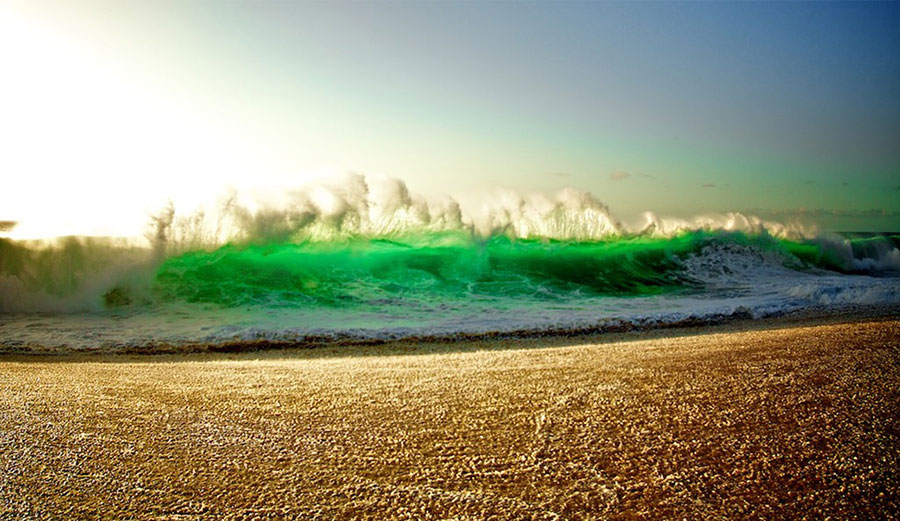
By 2100 the ocean will see level of acidification not seen in 14 million years—unless we drastically change how we’re living. Photo: Kenji Croman

A study by Cardiff University published in the journal Earth and Planetary Science Letters found that if we continue on emitting CO2 at the rate we’re doing today, by the year 2100, ocean acidification will hit levels not seen in 14 million years.
Right now, atmospheric CO2 is sitting around 400 parts per million, the highest they’ve been in millions of years. According to the study, if we don’t change a whole lot of the things that are major parts of our day-to-day lives, atmospheric CO2 would be near 930 parts per million by the turn of the century. And while that brings along a whole host of other problems, ocean acidification is one of the most important. When CO2 from the atmosphere is absorbed into the ocean, the water becomes more acidic which is bad for pretty much everything in it. Before we began blasting huge amounts of excess carbon dioxide into the sky during the industrial revolution (cue the people screaming about volcanoes), the planet could basically regulate itself. Then we came along and cranked the volume up so high we broke the dial. “Since the beginning of the industrial era,” wrote Cardiff University’s Julia Short, “the ocean has absorbed around 525 billion tons of CO2, equivalent to around 22 million tons per day.”
At the beginning of the early 1800s when we started using fossil fuel-powered machines to do pretty much everything, we entered a stage of advancement like never seen before. Exhaust-belching cars replaced farting horses. Industrialization basically created the whole urbanization phenomenon. Everyone piled into urban areas looking for work. The industrial revolution was good in a whole lot of ways—it is a foundation of the way we live our lives today—but, as Nat Geo put it, “the unfortunate consequence, however, has been the emission of billions of tons of carbon dioxide (CO2) and other greenhouse gases into Earth’s atmosphere.”
In the Cardiff study, researchers looked at fossils of sea creatures that lived near the surface some 14 million years ago. They looked at the chemistry of their shells to figure out the acidity of the seawater at the time they were alive. Using that information, they were able to create a traceable pattern of CO2 levels that was good enough to do a prediction of future carbon emission scenarios.
About 17-15 million years ago, during the Middle Miocene Climatic Optimum period, things were a lot warmer than they are now. The Andes, Sierra Nevada, and other giant mountain ranges formed, then created rain shadows that, over the course of millions of years, caused great expansions of grasslands, which in turn lead to the evolution of new species.
Then, roughly 14 million years ago, there was a wave of extinctions. It’s widely believed “to be caused by a relatively steady period of cooling that resulted in the growth of ice sheet volumes globally, and the reestablishment of the ice of the East Antarctic Ice Sheet.” You know why that cooling happened? Well, researchers believe that all that new grass and growth sucked up a crazy amount of CO2 that was floating around in the atmosphere and heating things up. Of course, there are a million other factors involved, but let’s try and keep millions of years of global patterns packed into a few paragraphs. Suffice it to say, however, that while all that happened over millions and millions of years, we’ve effectively vomited out so much excess CO2 that we’re changing things at a drastically faster rate—and the repercussions are already happening.
“Our new geological record of ocean acidification shows us that on our current ‘business as usual’ emission trajectory, oceanic conditions will be unlike marine ecosystems have experienced for the last 14 million years,” said the lead author of the study Dr. Sindia Sosdian. “The current pH is already probably lower than any time in the last 2 million years. Understanding exactly what this means for marine ecosystems requires long-term laboratory and field studies as well as additional observations from the fossil record.”

