
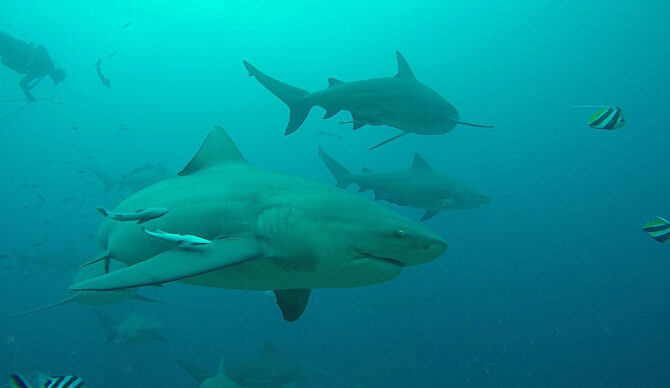
Bull sharks appear to have “friends.” Cute, right? Photo: Wikimedia Commons

It’s easy to attach human traits to animals. That’s because human traits are the only frame of reference we have. But it’s tough to know for certain if animals actually have the same emotions we do. Emotions like, say, loneliness, which can generally be solved by hanging out with friends. And while bull sharks are thought of as solitary creatures, a new study published in the journal Animal Behaviour found that they actually have friends — or what looks like friends to our human eyes.
“Understanding the mechanisms and functions underpinning social behaviour in marine species is a fundamental aim in ecology and conservation,” the authors of the study wrote. “Many shark species have relatively complex social bonds, and anthropogenic effects may affect these bonds. However, studying these effects remains a challenge because of the difficulty observing social interactions in many shark species.”
In order to look deeper into the social networks of bull sharks, researchers looked to the Shark Reef Marine Reserve (SRMR) in Fiji. It’s a place designated to the conservation of several different kinds of sharks, but it also provides scientists with a pretty great microscope. Large groups of bull sharks can often be found there, swimming around with each other on the hunt. In order to properly figure out just how much socializing they were doing and why, researchers spent six years identifying different sharks through markings or, if there weren’t any distinguishing characteristics, with ID tags.
“We identified individuals using two complementary methods,” Natasha Marosi, the study’s lead author, told IFLScience. “First many sharks can be recognized by distinguishing features such as scars, deformities, missing or damaged fins and distinctive coloration patterns. These features allow us to recognize the same individuals repeatedly. For sharks lacking these distinguishing features, we used small numbered aluminum identification tags. These tags were attached to a short leader wire and placed just below the first dorsal fin. This allowed us to reliably identify those individuals on subsequent dives and ensure we were tracking the same sharks over time. ”
They collected a lot of data over those six years. The teams logged 1,438 associations for 152 sharks, and 1,719 social interactions for 136 sharks. What they wanted to know for certain, however, was if those were just flukes that occurred because there were a lot of bull sharks swimming around near each other or whether they were swimming around with chosen partners. To do so, they created a system that allotted points for certain behaviors, like “parallel swimming,” “lead/follow,” and “join and turn back.”
“To test whether sharks were actually choosing specific partners, we compared the real social network with randomly generated networks where sharks would mix purely by chance,” Marosi explained. “The real network showed clear patterns of preferred partners and avoided partners, which tells us the sharks are actively choosing who they associate with.”
As it turns out, female bull sharks are far more likely to hang around with other females. Male sharks also preferred the company of females, but since the females would rather be with other females, the number of male-female “friends” were significantly lower.
“Males are also physically smaller than females which may encourage them to integrate socially,” said Marosi. “Having social connections to the bigger more dominant females in the aggregation can ensure their place within the group and give them access to food resources at the site.”
The scientists also found that as bull sharks age, they become less social. That could be because the social connections formed in younger sharks are a necessity of life as a shark. As they get older and learn more, they don’t need as much help from their peers.
“Our results suggest that older bull sharks become less socially connected as they age,” explained Marosi. “These individuals have many years of experience hunting, navigating their environment, locating resources and choosing mates, so they may rely less on social relationships in favor of self-reliance.”
While it might not seem like something we need to know, the findings offer insights on shark behavior that could help inform scientists regarding conservation strategies.

