
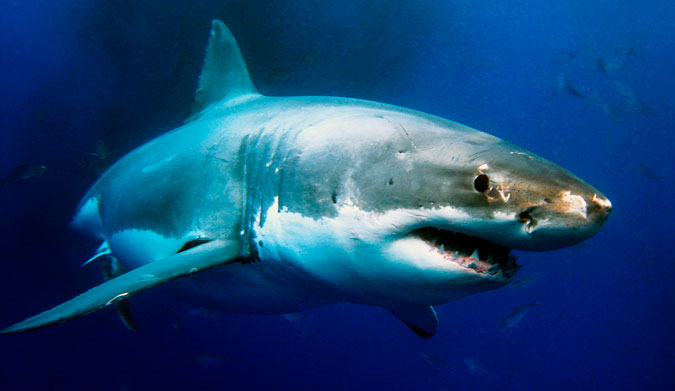
Great whites off the coast of South Africa have the lowest genetic lineage in the world. Photo: Shutterstock

Of all the sharks, the great white is undoubtedly the most feared. And it is understandable–for years, we’ve been told that they are creatures bent solely on our destruction; mindless killing machines with no care for human life. But they are a very important part of the delicate balance that is our ecosystem, and according to a four year study by the department of botany and zoology at Stellenbosch University, South African great whites are in very dire straits.
While great whites surely are killing machines (millions of years of evolution made them that way, which is why they’ve ascended to the top of the food chain as apex predators), they are not out to get us. Great whites are opportunistic, and as more of us enter the ocean and create conditions that drive them closer to shore in search of food, it stands to reason that human opportunities are more more frequent… which is fucking terrifying, but it’s a situation we have created, and simply killing a whole whack of them–which, by the way, we’re already doing in the form of useless culls and finning–isn’t the smart way to go about fixing our mess. From a purely selfish standpoint, if we kill off an apex predator, we’ll find ourselves in a far worse situation than the one we’re in now.
According to the study done by Stellenbosch University, which concentrated on whites and their DNA in South Africa, the genetic diversity of those particular great whites is the lowest in the world–and it is staggeringly low. “We found only four maternal genetic lineages in the South African population, with 89% of all the sharks sharing the exact same gene sequence,” said Dr. Sara Andreotti, who headed the study as part of her doctoral research.
In case you didn’t read that properly, there are only four genetic lineages. FOUR. In the entire population of great whites off the South African coastline. So why should genetics matter? Well, it goes back to evolution, in a roundabout way. A bigger diversity means more chances for shark populations to fight off disease or environmental changes. Think of Alexei Nikolaevich, Tsarevich of Russia. The world’s most famous hemophiliac was rumored to have contracted the disorder through generations of inbreeding. In a diverse genetic pool, chances are far higher that poor little Alexei could have cut his knee or bloodied his nose and not had to worry about dying or running to Rasputin to get some herbs or whatever he gave him. Of course, that’s an extreme example, but you get the point: four genetic lineages in a huge (although dwindling) population of sharks is not a deep gene pool, and leaves any and all offspring exponentially more susceptible to being, well… weaker. And as an apex predator responsible for regulating a large portion of other species’ populations, weak is bad. Which, again, is bad for us. We should be looking out for the sharks, because that means we’re looking out for number one.
By the end of the four year study, researchers collected just over 300 samples. They then compared it to the DNA of nearly 60 other whites in different parts of the world. “The poor gene pool could be the result of a severe bottleneck or historical local extinction and re-colonization processes,” Andreotti explained. “Our main and immediate concern now is to understand the potential negative effects the low levels of genetic diversity can have on South Africa’s white shark population.”
Apart from the scarcity of different lineages, they did find something else of interest. The whites off the South African coastline have a unique lineage that isn’t found anywhere else in the world. “Based on the data, we could predict a west to east migration pattern and an ancestral link between the white sharks of South Africa and Florida,” Andreotti said. “But we also found a unique South African female lineage that does not connect to any other lineage in the world. It appears from this study that all white sharks originated from one common ancestral group in the Indo-Pacific Ocean around 14 million years ago.”
One would hope that their findings would most certainly have an impact on South Africa’s shark population management in the future, but if our track record is any indicator, they probably won’t.
“It is obvious that current conservation measures should take the low levels of genetic diversity into account,” Andreotti concluded. “Otherwise, one of these days we will not have any white sharks left to worry about.”

