
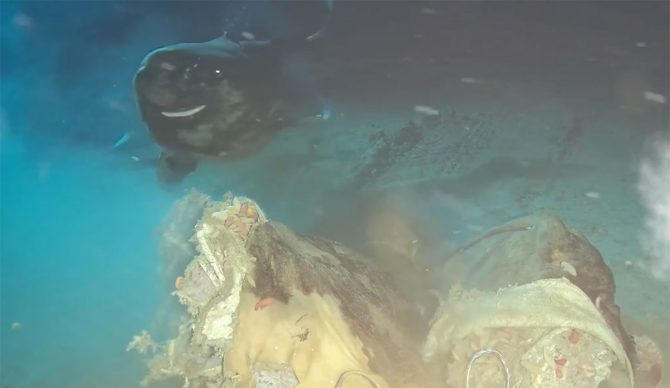
Free lunch makes this Pacific sleeper shark smile. Photo: Science Partner Journals

It can be tough to figure out things about creatures that live in the deep sea. In the case of the Pacific sleeper shark, details on how they breed, how they eat, where they travel, and just how they live in general are as murky and dark as the places they live. So what do scientists do when they want to get more information? Dump a dead cow overboard and film what happens.
Researchers in the South China Sea decided that they needed to know more about what one of nature’s most elusive sharks does when a whale carcass hits the sea floor, and since it’s tough to drop a dead whale where you want one, they opted for a cow. Researchers motored out to a spot near Hainan Island with their carcass, found a good spot that was a little over 5,000 feet deep, and hucked the dead animal in. Then they dropped a few cameras down and sat back to watch what happened.
As it turned out, Pacific sleeper sharks aren’t wildly aggressive feeders, at least in this case. The famed shark feeding frenzy that one might expect was replaced by a civil meal where sharks voluntarily moved out of the way to let others have a bite. But it’s not clear why, exactly, that might’ve happened.
“Sharks yielded their positions to individuals approaching from behind,” the researchers wrote in a recently-released study. “External scars were visible on the pectoral fin of the second shark in the queue, possibly resulting from a previous intense confrontation. Was the seemingly polite queuing order observed between these two Pacific sleeper sharks in the deep sea a coincidence? We think that the queuing behavior observed in the deep sea closely resembles the hierarchical feeding patterns observed when sharks are scavenging from large floating whale carcasses at the surface. However, we cannot rule out the possibility that the first shark departed to avoid competitive risk. This behavior suggests that feeding priority is determined by individual competitive intensity, even in deep-water environments, reflecting a survival strategy suitable for non-solitary foraging among Pacific sleeper sharks.”
In the video you see here, courtesy of Science Partner Journals, eight sharks showed up for the free lunch. It appeared that the ones that were larger than about nine feet were the more aggressive of the bunch in this particular instance. The smaller ones were a little more timid, circling the carcass politely instead of diving in like they were starving. This behavior led the researchers to another question.
“The highly aggressive behavior of sharks observed in the South China Sea [in the vide] suggests that this region still harbors abundant food sources in the deep sea,” said Han Tian, the author of the study describing the findings, in a statement. “But what exactly are they? This question is intriguing for both animal distribution and behavioral research.”

