
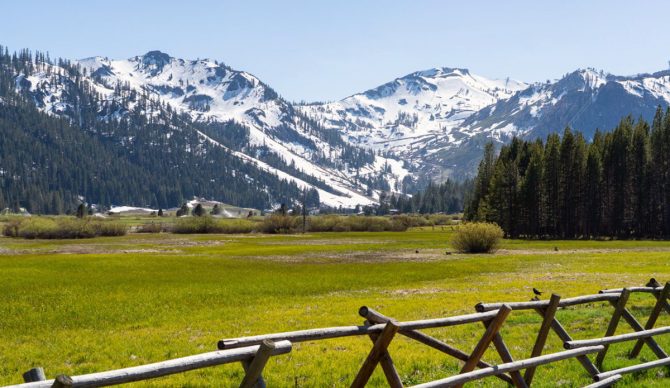
Olympic Valley in all its glory. Photo: Blake Kessler//Palisades Tahoe

Fourteen years of contention between Palisades Tahoe and Tahoe-based environmental groups has come to an end after a settlement was reached on a development project at the North Lake Tahoe ski resort. Palisades Tahoe (formerly known as Squaw Valley, host of the 1960 Winter Olympics), Keep Tahoe Blue, and Sierra Watch issued a joint statement announcing a settlement that will reduce the scale of the new development in Olympic Valley.
“Sierra Watch, Keep Tahoe Blue, and Palisades Tahoe negotiated in good faith to find a solution that effectively ends the 14-year conflict over Olympic Valley while supporting the social, economic, and environmental needs of Olympic Valley and the Lake Tahoe region,” the statement reads.
As part of the agreement, Palisades reduced the total number of bedrooms in the expansion plan by 40 percent and the total new commercial space by 20 percent. They agreed to scrap plans to build a controversial indoor water park and will instead construct a smaller adventure center. Additionally, Palisades will not develop parcels of land at the mouth of nearby Shirley Canyon, leaving the land as protected open space, and they committed to no further development for the next 25 years.
If Placer County approves the updated plans, it will mark the end of the 14-year stalemate between the largest resort in the Tahoe area and the environmental groups.
Among those welcoming the compromise is professional big mountain skier and Tahoe resident Cody Townsend, who expressed optimism about the settlement.
“I feel like this is the best possible outcome of all potential outcomes,” Townsend told The Inertia via email. “Coming to an agreement where all parties are happy is absolutely incredible. I’m sure it took sacrifices from all sides and I’m grateful that all parties did what it took to end this 14-year struggle and move forward positively.”
“Honestly, it gives me a lot of hope that we can address serious needs of development in the Tahoe region, like building workforce housing, while also being able to engage with the community in the process,” he added. “Very stoked.”
The battle dates back to 2011 when Palisades put forth a proposal to build enough new hotels, timeshares, and residential units for 2,884 bedrooms, mostly over a parking lot in Olympic Valley. A revised plan, which included 1,493 bedrooms, was released in 2014 to appease local opposition. Although it was approved by the Placer County Board of Supervisors in 2016, California courts rescinded the approval in 2021, ruling that the project violated the California Environmental Quality Act – a victory for the conservationists.
In 2022, the parent company of Palisades, Alterra Mountain Company, submitted a new entitlement application that essentially re-proposed the same project. Then, in November 2024, Placer County approved the plans for 850 units and 297,000 square feet of commercial space. A month later, the environmental groups sued, resulting in seven months of negotiations that produced the July 8 settlement.
The final plan reduces the commercial space to 222,000 square feet and the lodging development to 896 bedrooms. After studies said that the previous proposal would introduce 1,353 more cars into the Tahoe basin on a normal day, the new plans reduce car traffic by 38 percent.
The settlement retains previous commitments by Alterra to build housing for 386 employees, along with a $2 million donation to the Tahoe Regional Planning Agency to upgrade transit.
Palisades Tahoe COO Amy Ohran called the negotiations a “different approach” and stated she feels “good about the outcome.”
One major hurdle that opponents of the project faced is that Palisades sits a mere four miles outside the region delineated as the Tahoe Basin; it is not bound by existing, stricter environmental regulations that limit the breadth of such developments.
“Tahoe is important enough that we’re going to fight for it no matter what, with any tools available to us,” Jesse Patterson, chief strategy officer for the League to Save Lake Tahoe, told SFGATE. “But the best solutions come when we can sit down and talk together about how to get there. And you get there faster. As soon as we had that conversation, you can see how quickly we got to something.”

