
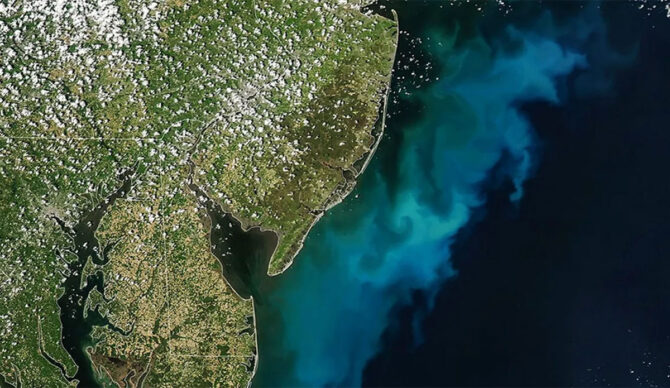
An enormous phytoplankton bloom can be seen from space off the Eastern Seaboard of the United States. Photo: NASA Earth Observatory/Michala Garrison

In the middle of April, NASA researchers watching the images coming back from satellites began to notice something strange. Pretty, but strange. Huge plumes of colorful waters were beginning to swirl off the coast of the US Eastern Seaboard. They marked it down and decided to keep an eye on it. By May, it was clear that something enormous was happening: a phytoplankton bloom of truly massive proportions.
“Many types of algae, including cyanobacteria, dinoflagellates and diatoms, can generate massive populations with densities greater than 15,000,000 cells per liter, stretching for hundreds or even thousands of square kilometers in water bodies,” Kyle Scotese, who works at the International Society for Diatom Research, told IFLScience. “These blooms can proliferate and dieback in a matter of days or return seasonally for decades.”
While these blooms do happen at certain times of the year, they’re not usually as big as this one. It stretches along the coastlines of New Jersey, Delaware, Maryland, and Virginia, it consists of sediment stirred up from river outflows, upwelling, and a huge proliferation of algae.
This particular bloom, according to NASA researchers, is likely made up mostly of diatoms, a group of single-celled, photsynthetic algae that’s found in oceans all over the world. Despite their tiny size, diatoms are crucial to our environment. They are responsible for around 20-30 percent of the world’s oxygen and close to 50 percent of the photosynthesis that happens in the ocean.
“The color of the ocean is determined by the interaction of sunlight with substances or particles present in seawater such as chlorophyll, a green pigment found in most phytoplankton species,” NASA explained. “By monitoring global phytoplankton distribution and abundance with unprecedented detail, the [Ocean Color Instrument] helps us to better understand the complex systems that drive ocean ecology.”
It’s likely that this enormous bloom won’t have any ill effects and will dissipate on its own in the next few months, but since phytoplankton blooms are so important, researchers plan on keeping a very close eye on this one to ensure that things don’t get bad — or at least if they do, we’ll have some warning.
“Under extreme conditions, there can be so little oxygen that fish can’t survive, leading to ‘fish kills,’ where hundreds or thousands of fish may die and float at the surface,” NASA wrote. “In areas that receive an extra dose of nutrients from man, particularly from fertilizer in runoff from agricultural areas, organic matter production is artificially increased. Thus, when respiration takes over in the warm surface waters, oxygen concentration decreases more than for ‘normal’ conditions, possibly causing an increasing occurrence of fish kills.”

