
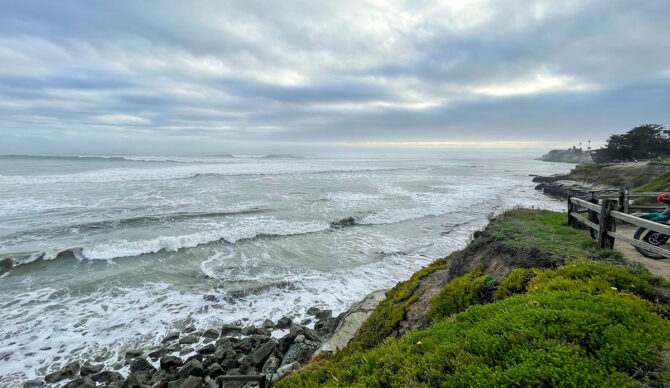
A new proposal could ban motorized fishing at Pleasure Point. Photo: Evan Quarnstrom

The groups behind a proposal to create a new marine protected area (MPA) at Santa Cruz’s Pleasure Point have scaled back restrictions in response to feedback. Some opponents, however, remain firmly against any new limits on fishing in the area.
The updated proposal, put forward by the conservation groups Environment California and Azul, would now allow non-motorized recreational fishing within the proposed reserve. The original plan called for a 3.2-mile no-take zone along Santa Cruz’s east side from Rockview to Trees Beach. Under the amendment, fishing would still be permitted from non-motorized crafts.
Laura Deehan, state director of Environment California and the primary contact listed on the petition, said there is no precedent in California for managing this type of restriction. The groups are awaiting evaluation from the California Department of Fish and Wildlife to determine how the proposal might be implemented.
The most vocal opposition group, All Waters Protection and Access Coalition, which has Santa Cruz representation on its board of directors, says it is not satisfied with the revision. The group, which describes its mission as protecting the “rights of freedivers and anglers” and counts several high-profile Santa Cruz surfers among its supporters, argues that science does not justify stricter protections for Santa Cruz’s healthy kelp forest.
How we got here
In November 2023, Environment California and Azul filed a petition to expand six marine protected areas in California and to add a new one off Pleasure Point. The proposal was driven by two overlapping goals: advancing the Marine Life Protection Act and California’s “30 by 30” initiative, which aims to protect 30 percent of the state’s land and coastal waters by 2030. While kelp forests in other parts of California have suffered severe declines, those in Monterey Bay have proved to be resilient during marine heat waves.
The groups cite research from scientists at Stanford University’s Hopkins Marine Station in Monterey Bay, arguing that thriving kelp ecosystems should receive additional protections to prevent future loss.
All Waters counters that the resilience of kelp in the region is precisely why new restrictions are unnecessary. The coalition, which has counted on the support of well-known Santa Cruz surfers such as Shawn Dollar and Kyle Thiermann, says existing fishery management rules already in place are sufficient.
Neither All Waters, Azul, nor Environment California has concrete data on how many fish are currently being removed from the proposed reserve area, making it difficult to quantify the potential impact of new restrictions.
Santa Cruz Mayor Fred Keeley initially expressed support for the proposal but later walked back his position, citing a lack of scientific data. He did not respond to a request for comment on the amended version.
Since late 2023, the petition has moved through hearings, a public feedback process, and revision. State officials encouraged the groups to broaden stakeholder engagement, which ultimately led to the amended proposal now under review.
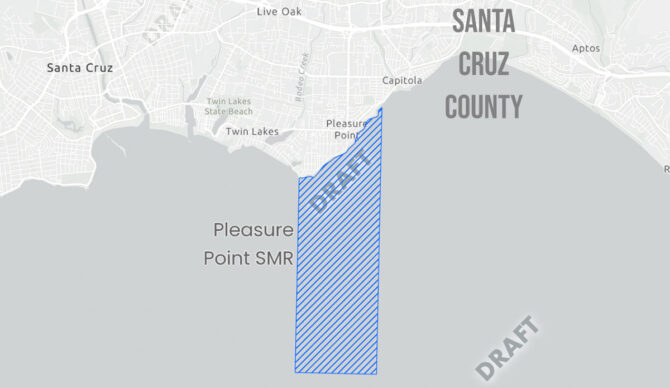
The extent of the proposed marine protected area. Photo: California Department of Fish and Wildlife
Why the proposal was amended
Deehan said organizers reviewed several years of public comments submitted to the California Fish and Game Commission and found a range of opinions on both sides. She said some commenters did not understand the implications of an MPA, mistakenly believing it would restrict recreational use.
“If you have an area of the ocean that’s in a marine protected area with really limited extraction happening, we do see significant benefits,” Deehan argued. “We thought (the amendment) would be a middle ground.”
She said the groups consulted again with scientists at Stanford’s Hopkins Marine Station before revising the proposal to ensure it was scientifically sound, and accused All Waters of cherry-picking data from studies – including some studies also cited by supporters of the proposal — and using it out of context.
Deehan also argued that marine protected areas can provide economic benefits, pointing to examples in La Jolla and Point Lobos.
“California has lost more than 90 percent of its kelp forests in the last decade,” Deehan said. “When you look at a 50- or 100-year timeframe, it’s closer to 99 percent. The healthy, vibrant kelp forest we still have in places like Santa Cruz makes a strong case for giving it more protection to reduce future impacts.”
Local opposition
Matt Bond, chief strategy officer for All Waters, characterized the proposal as a rushed application of a powerful regulatory tool. He cited a 25 percent budget cut to the Department of Fish and Wildlife and questioned whether the state has adequate resources to thoroughly assess the relevant impacts.
“The most frustrating part of all of this is there’s no money,” Bond said. “Our tax money goes to a lot of things, but not enough goes to protecting clean water, fish, and kelp. If I could ask anything, it would be for the state government to better fund fish and wildlife.”
Bond argues that in Northern and Central California — unlike parts of Southern California — there is no clear evidence that eliminating sustainably managed fishing would restore kelp forests. He points instead to marine heat waves and the die-off of sunflower sea stars, key urchin predators, as primary drivers of kelp decline.
“The petition is, at best, an over-application of the precautionary principle,” Bond said. “Kelp generally grows in waters up to about 90 feet deep, and they’re proposing protections out to three miles offshore. The scale doesn’t match the problem.”
Kyle Thiermann, a local sponsored surfer and author, echoed these concerns. He said fishing at Pleasure Point is already managed sustainably, and restricting it could alienate locals who might otherwise support conservation groups like those behind the MPA proposal. He added that he is open to being convinced when he sees scientific evidence that justifies such measures.
“There are other parts of the world I fully support MPAs, but Pleasure Point isn’t one of them,” Theirmann said.
Despite the concessions by Environment California and Azul, Bond said he doesn’t support the MPA under any circumstances. He also argued that the groups behind the petition failed to engage enough local stakeholders, and noted that many anglers who fish in Santa Cruz waters live inland and also have been underrepresented in the discussion.
“MPAs don’t help with water cleanliness, marine heat waves, microplastics, or estuary loss. They don’t help with any of that. The only thing MPAs do is regulate already sustainably managed fishing,” said Bond.
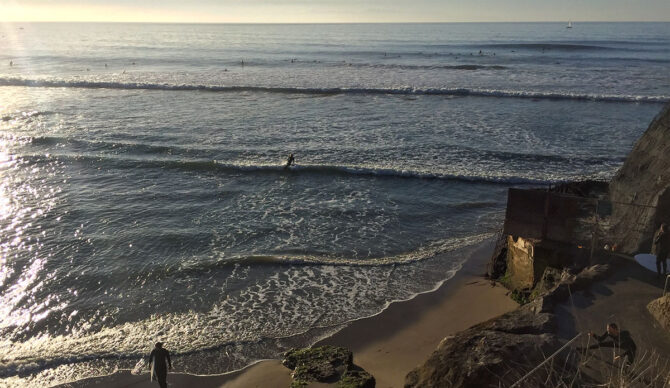
Pleasure Point is the hub of surf culture on Santa Cruz’s east side. Photo: Evan Quarnstrom
The finish line
Azul’s executive director and founder, Marcela Gutiérrez-Graudiņš, rejected the idea that coastal residents should have more influence than other Californians.
“We have been told that one voice matters more than another,” Gutiérrez-Graudiņš said. “As far as I’m concerned, the California coast belongs to everybody.”
“Someone 300 miles inland is as important as someone who lives on the coast,” she added. “We cannot decide that the ocean is only for locals.”
Still, both Environment California and Azul say they have conducted outreach in Santa Cruz, including stakeholder meetings attended by All Waters. They maintain that local support exists and describe opposition as coming from a small but vocal minority.
“I think it would be a shame if the self-interest of a small number of people who happen to be really loud got in the way of protecting our ocean and our coast for future generations,” Deehan said.
For those who want their voices to be heard, the next regional meeting on the petition is scheduled for April 21 at a location to be announced near Half Moon Bay.

