
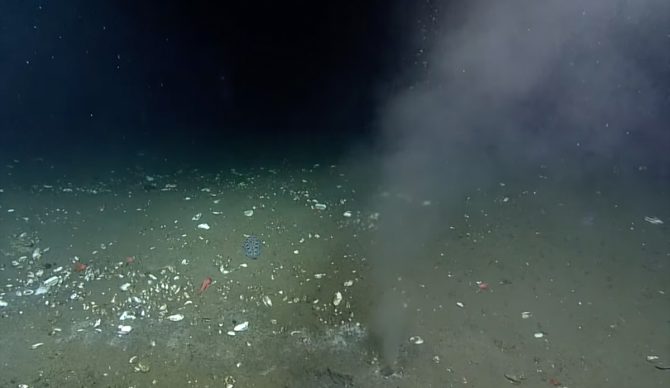
Pythia’s Oasis is an odd piece of the world where fresh water leaks from under the sea. Photo: University of Washington

About a decade ago, an oceanographer named Brendan Philip accidentally discovered something weird when he was poking around the Central Oregon segment of the Cascadia Subduction Zone. The ocean floor, apparently, was leaking.
The Cascadian Subduction Zone, a strike-slip fault that runs along the coastline of the Pacific Northwest, is the meeting of two tectonic plates. Those plates rubbing against each other are what causes earthquakes.
“The megathrust fault zone is like an air hockey table,” said Professor Evan Solomon, a seafloor geologist, in a 2023 press release about the discovery. “If the fluid pressure is high, it’s like the air is turned on, meaning there’s less friction and the two plates can slip. If the fluid pressure is lower, the two plates will lock – that’s when stress can build up.”
That “leak” that Philip found? It was coming from 2.5 miles beneath the seafloor where the plates meet. A study led by the University of Washington had scientists aboard the RV Thomas G. Thompson when they saw a large bubble flume rising up beneath them as they sailed about 50 miles off Newport, Oregon. Whey they looked deeper, they found that the bubbles were coming from a warm, nearly salt-free source.
“They explored in that direction and what they saw was not just methane bubbles, but water coming out of the seafloor like a firehose,” said Solomon. “That’s something that I’ve never seen, and to my knowledge has not been observed before.”
In the weeks that followed, the deep sea spring was named Pythia’s Oasis, after Ancient Greece’s Pythia, an oracle who sat in a temple above a crack in the Earth and breathed in the gasses that it emitted in order to predict the future.
The reason that leak gave researchers a worrisome pause is because that water that’s hidden away under the tectonic plates needs to stay there. “Observations from later cruises show the fluid leaving the seafloor is nine-degrees Celsius (16 degrees Fahrenheit) warmer than the surrounding seawater,” the University of Washington wrote. “Calculations suggest the fluid is coming straight from the Cascadia megathrust, where temperatures are an estimated 150 to 250 degrees Celsius (300 to 500 degrees Fahrenheit).”
That water beneath the surface of the ocean is pretty important because the pressure it is under decreases that friction of the plates as the they slide over each other. When the friction decreases, the plates can get stuck until the pressure builds up to a point where they release. And that is where earthquakes come from.
Since we’re talking about forces far more powerful than we are, there’s not a lot we can do about it except for keep an eye on things in case anything strange happens.
“Pythias Oasis provides a rare window into processes acting deep in the seafloor, and its chemistry suggests this fluid comes from near the plate boundary,” Deborah Kelley, an oceanographer and one of the authors on the study, said in a press release.
We don’t have much to worry about, though, and “scientists are not too alarmed at discovering this geologic feature, which does not trigger earthquakes but may regulate friction in the fault zone.“

