
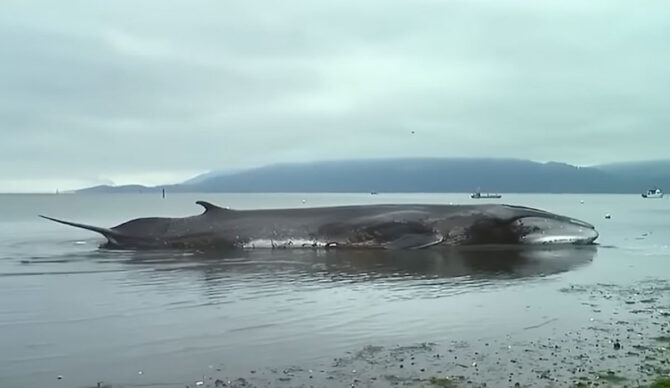
The fin whale died on May 5 after rescue attempts proved impossible due to its size. Photo: YouTube//Screenshot

On May 5, an 80,000-pound fin whale died after beaching itself on the tidal flats of Samish Island in Skagit County, Washington. It was a heartbreaking sight for the small community.
The whale was 61-feet long. It somehow ended up in the shallows and got stuck in the sand as the tide receded. At 80,000 pounds, it was an impossible job to tow it out. Residents watched as it struggled, its tail flappy and its huge mouth opening and closing as though gasping for air. It appeared to be severely malnourished, and despite several organizations rushing to the scene to attempt a rescue, it died on Tuesday, May 5. While necropsies are underway, the cause of its death isn’t known at the time of this writing.
Fin whales are the second largest creature on Earth, surpassed only by the blue whale. Their average weight is around 100,000 pounds, but they are filter feeders that eat mostly krill, herring, and the occasional squid. The fin whale is so-named because of the hooked dorsal fin it carries on its back, and it can make a tremendous racket.
“Fin whales create some of the loudest natural sounds in the ocean, which are often recorded by OBS stations monitoring seismic frequencies,” writes The International Fund for Animal Welfare (IFAW). “Thought to be breeding displays, male fin whales produce one-second vocalizations up to 40 seconds apart for as long as 10 hours. These sounds are loud enough to be heard more than 30 kilometers (18.6 miles) away.”
Fins whales have had a rough go in the last 100-or-so years. From the early 1900s to the ’70s, they were hunted mercilessly until they were very nearly extinct. Now, thanks largely in part to commercial whaling restrictions, the fin whale is making a comeback, but they’re still listed as “vulnerable” on the IUCN Red List. Up until 2018, they were considered to be endangered.
It’s been an awful year for whales in the area — gray whales especially. In April alone, 16 grays washed up in Washington State. Four of those appeared to have been struck by vessels, and one showed signs that it had been entangled in fishing net. Seven more gray whales have died in neighboring British Columbia.

