
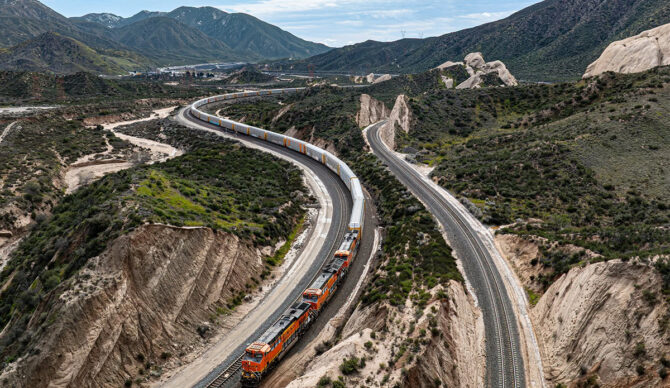
Cajon Pass east of Los Angeles is looking primed for a quake. Photo: MP Rail Photography//Facebook

The southern San Andreas Fault has reached stress levels unseen in at least 1,000 years, according to new research that suggests the fault is ripe for a major earthquake. Scientists at the University of Hawaii found a stretch near Los Angeles that is in a “critically loaded state” after going more than 160 years without a major rupture.
The area of concern is around Cajon Pass, where the 15 freeway crosses the Transverse Range from Riverside to the Mojave Desert. The pass is where the San Andreas and San Jacinto faults meet, making it a tectonically active zone prone to large earthquakes.
The last big quake in the area was in 1857 at Fort Tejon, estimated at 7.9 on the Richter scale. Before that, a large quake of 7.5 struck in 1812. The region has experienced at least 36 quakes of 6.4 or larger in the last millennium. But scientists say records show large ruptures on this stretch of faults occur every 100 years or so. It’s been more than 160 years since the last large-scale quake, and models confirm that the tension observed is unprecedented.
The researchers are careful not to use alarming language. But, at the same time, they are pretty clear in deducing that the next time the plates slip east of Los Angeles, it could be catastrophic.
“This is not a prediction of when an earthquake will happen,” said the study’s lead author, Liliane Burkhard. “What we can say is that the system is critically stressed, and that physics-based models like this one give us a clearer picture of the range of scenarios we should be prepared for.”
The authors say this information can help cities plan infrastructure, prepare emergency protocols, and adapt building codes.
When the big quake does occur, the chances are relatively low that it triggers a massive tsunami. Not only is the fault intersection 60 miles from the ocean, but it’s a strike-slip fault, meaning the two plates slide side by side. Though this type of fault can produce tsunamis, tectonic boundaries where one plate subducts under the other are more conducive to creating big waves.
California has only registered one quake above seven on the Richter scale in the 21st Century. In 2019, a 7.1 quake struck Ridgecrest in the Mojave Desert.

