
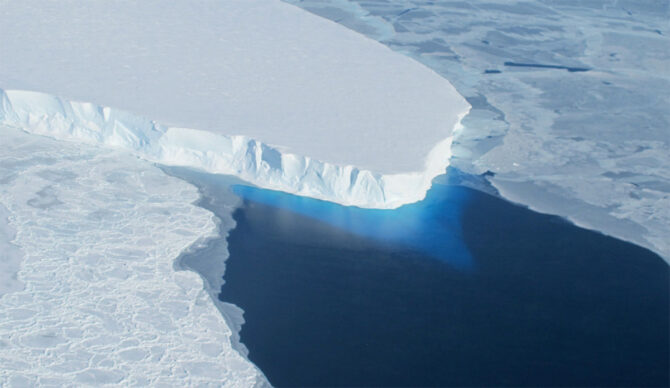
The Seabed Curtain Project has a plan. A crazy one. Photo: NASA

Thwaites Glacier, better known as the “Doomsday Glacier,” is in rough shape. It has enough frozen water in it to raise global sea levels by a tad over two feet — which would be absolutely devastating to many places around the globe — but there’s a plan hatching that’s straight out of a science fiction movie: build a giant wall around it.
Now, one would be excused for thinking that this seems a little far-fetched. That’s because it is far-fetched, but hell, going to the moon seemed far-fetched in the ’50s, and look what happened in 1969. One small step, right? As science advances, two things can happen: we can plunder the planet for resources needed to create the things advances in science affords us, and we can also attempt to solve the problems that come along with plundering the planet for resources.
If the project, called the Seabed Curtain Project, were to go ahead, it would be both a monumental undertaking and achievement. To make any real difference, it would need to stretch over 50 miles and be nearly 500 feet high. That alone would be a big fence to make, but this one would need to be be built over 2,000 feet down in a very inhospitiable part of the ocean. It would also need to be able withstand everything that inhospitable part of the ocean can throw at it — and it can throw a lot. Billions of dollars would need to be spent to make it a reality, but despite all of those seemingly impossible hurdles, the Seabed Curtain Project isn’t daunted.
“Just because it’s extremely difficult is not an excuse not to try,” Marianne Hagen, co-lead of the Seabed Curtain Project and former deputy minister of Foreign Affairs of Norway told IFLScience. “For me, it’s kind of a no-brainer. If it’s possible to take 65 centimeters of global sea level rise off the table for everybody, with one single targeted intervention in one location, I’m willing to explore it. I think we have an obligation to do so.”
It’s not a great sign that people are considering something this drastic to leave a habitable planet for future generations. First things first, we’ve got to figure out a way for all of us to stop belching all manner of filth into our home planet.
“I truly believe that reducing emissions is what’s going to save the planet,” Hagen continued. “There is no way around it, with or without any climate interventions.”
You likely know what’s happening up there on the northern edge of the West Antarctic Ice Sheet, but here’s a quick explanation: Thwaites Glacier is on the edge of West Antarctica. It’s about the size of Florida and is the widest glacier in the world, spanning some 80-or-so miles. It’s melting incredibly quick from all sides, including the underside, which is a tad worrisome considering the amount of ice it holds. As oceans warm, glaciers around the world are melting at alarming rates that have doubled from the ’90s to the 2010s. There are some estimates that the glacier could collapse entirely in the next two or three decades, which affect billions of people around the world. Avoiding that is… well, it’s good. The Seabed Curtain Project believes that installing a fix now will be cheaper than fixing the damage later.
“If you compare [the project costs] with the coastal repair and damage cost, it’s a fraction,” Hagen explained. “The cost of this project will run in billions. The cost of the damages will run into trillions.”
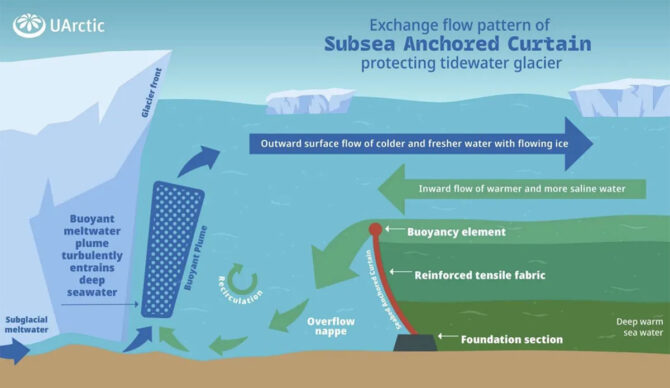
The Seabed Curtain Project has a crazy idea. So crazy it just might work! Image: University of the Arctic
The reason the Doomsday Glacier is melting so quickly is because there’s a stream of warmer water that’s getting into a gap between the continental shelf and the glacier itself. The plan would be relatively simple, if not for the scale of it. Basically, a series of huge “curtains” would be anchored to the seabed. The top of them would be made of something that floats. The hope is that that would lessen the amount of warm water flowing under the glacier, slowing down its melting rate.
Obviously, this is still a bit of a pie-in-sky idea, but a team of scientists from all over the globe have assembled and are working on it. One of the first steps for the Sea Curtain Project is a small-scale test.
“One of its most intriguing research efforts, conducted in collaboration with other organizations, is focused on the Van Mijenfjorden in the Arctic archipelago of Svalbard,” wrote IFLScience. “This fjord is a body of water that’s naturally shielded by an island at its mouth, making it a useful real-world analog for studying how an artificial barrier might influence water temperatures, ice stability, and marine ecosystems in a polar setting.”
That’s smart, because just heading to Antarctica with a bunch of giant curtains and cement would be a dumb idea.
“It would be absolutely insane, from an economic perspective, to go straight to Thwaites and start building something. We need to test this at a much lower cost, in less harsh conditions,” said Hagen.

