
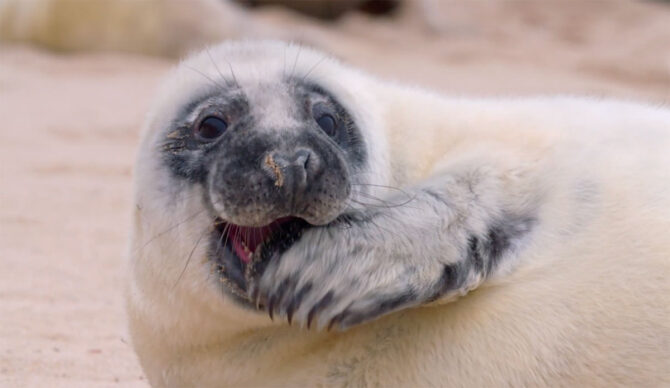
Seal pups are being ripped apart by bull seals. It took decades to figure out. Photo: Sable Island National Park//Screenshot

Back in the 1980s, when the Iran-Iraq War was raging, Chernobyl was melting down, IBM was birthing the digital revoltion, and John Hughes was making the best coming-of-age movies in history, people began noticing something awful happening on the east coast of Canada. Dead seal pups were washing up, torn through from mouth to guts, their little seal pup innards exposed to the elements, seemingly cut open by some sort of corkscrew-type thing. When researchers began to keep an eye on things, they noticed it only appeared to happen during breeding season. For decades, the trend continued with no answer in sight. Now, though, the mystery has been solved.
At first, scientists thought that there could be someone awful running around and gutting baby seals for fun. Or perhaps the poor seal pups were suffering from boat propellor strikes. Maybe it was sharks. But since no one ever actually saw anything happen, it was tough to tell for sure.
But then Izzy Langley, a marine ecologist at the University of St. Andrews in Scotland, took a trip to Sable Island, a tiny speck of land off the coast of Nova Scotia. There’s a massive gray seal population there, so for those studying seal habits, it’s a place of interest. What Langley saw one day would be the answer to the old question of who or what was killing the pups in such a grotesque way. Langley and her colleagues watched in horror as an adult male gray seal took a healthy, weaned pup and ripped it to shreds.
“It held the seal pup by the back of the neck and proceeded to tear off pieces of flesh,” she wrote in a paper describing the events, “repeatedly tilting its head back indicative of feeding behavior.”
Over the next 10 days, Langely’s team saw two more pups killed. A year later, it was proved beyond a shadow of a doubt when, on January 7, 2025, “an adult male gray seal was filmed restraining a live, healthy looking weaned seal pup with its head in its jaw.”
You know that the natural world is a cruel place. Seals need to kill to survive, as cute as they are. Researchers know this, and although similar killings in Scotland and Germany in the 2010s were proven to be caused by other seals, the researchers on Sable Island were hesitant to accuse that population of the same thing.
But when Langely headed out to get a handle on just how many seal pups were being killed, she found that over 500 of them were slaughtered on the island’s northern beach alone, with about 250 killed on a southern beach. On closer inspection, it was no longer in doubt: the seal pups were being ripped apart by other seals. The bull seals, to be exact.
While it might seem a little strange that the researchers weren’t able to definitively say how the pups were being killed for 40-some-odd years, it might help to remember that these seal colonies can be absolutely enormous. There are tens of thousands of them all barking and fighting and basking during mating season, so catching a lone male massacring little baby seals in the act isn’t a simple task.
“It suggests that gray seal intraspecific predation events mostly occur at times or locations where direct observations are unlikely,” the authors of the study explained. “For example, at night, at sea, during high tide, and/or in stormy conditions.”
That leaves researchers in a bit of a conundrum: should they do something about it, or should they let nature take its course? Right now, nothing is planned. But since the attacks aren’t limited only to gray seal pups — harbor seals, a species that’s not doing nearly as well population-wise as the gray seal, are being killed too — researchers may recommend something in the future.
“There are an estimated 80,000 gray seal pups born annually on Sable Island, which represents around 80 percent of the breeding population in the northwest Atlantic,” the paper states. “Although there is currently no evidence that the predation of juvenile gray seals in the northwest Atlantic is impacting the gray seal population trend […] the collapse of the harbor seal population on Sable Island should be investigated in the context of gray seal predation and the potential impact this could have on marine mammal population dynamics.”

